

When we talk about the heavenly hierarchy, it's essential to know that archangels are not your everyday celestial beings. Unlike regular angels, who dutifully carry out smaller tasks or offer quiet comfort, archangels are the power players—messengers with an authority that echoes through millennia. Think of them as cosmic celebrities, with roles that include waging spiritual battles, ushering in life-changing revelations, and even meddling in the affairs of us mere mortals.

Among these titanic figures, names like Michael, Gabriel, and Uriel resonate with authority; yet, it is St. Raphael whose story we will focus on today. As the patron of travel, healing, and protection, his divine presence has been felt by many, setting the stage for the astonishing tale that started in the 16th-century and is still unfolding today.
The black plague hits Spanish towns
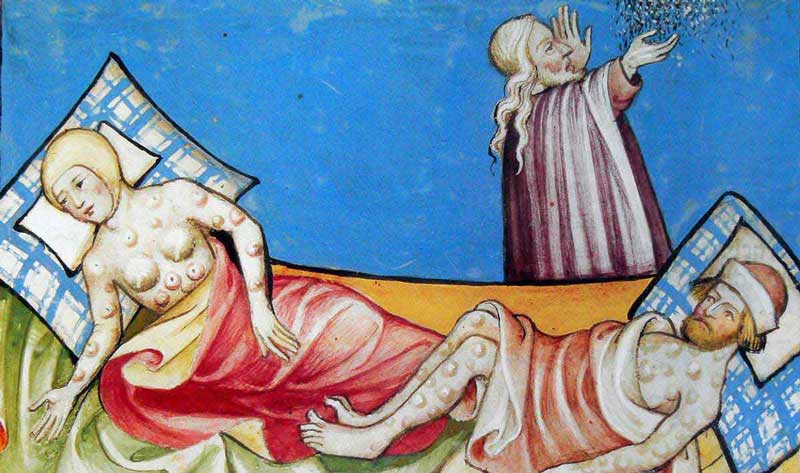
The year is 1578. The place, Córdoba. A city where chaotic pandemonium mimicked the relentless uncertainty of our own 2020 pandemic. As the bubonic plague tore through its streets, hospitals overflowed, families hid in desperate isolation, and the stench of death lingered like a dark omen in the air.
Amid the gloom stood a humble Franciscan priest named Father Andrés de las Roelas near his Church of San Lorenzo, which stood at the heart of the pained and grieving city. He knelt in prayer, tears mixing with the dust of desolation, when a radiant figure emerged from the shadows. A young man with flowing hair, dressed in the worn garb of a traveler, appeared holding a staff and a fish. With a voice that resonated like a clarion call from above, he declared, “I am Raphael, one of the seven angels who stand before the throne of God. The Lord has heard your prayers. Place my image in the city, and the plague shall cease.” The air trembled as the divine promise set in motion events that would redefine Córdoba’s destiny.
A Closer Look at the Celestial Icon

Before we journey further into that fateful moment, let’s take a quick detour into the life and legacy of St. Raphael. He was not a historical figure as is the case with other Saints. He, along with the other Archangels had no physical presence on earth, but only a heavenly one. The name “Raphael” comes from the Hebrew word for “God heals,” and it’s no coincidence. This archangel has long been venerated as the patron of travelers, the blind, bodily ills, happy meetings, healing, protection, nurses, physicians, and medical workers.
His feast day started out on October 24th, 1921, but was moved to September 29 in 1969 to coincide with the feasts of Saints Michael and Gabriel. St. Raphael’s iconography is rich with symbolism. Look for depictions featuring a youthful, radiant figure often accompanied by a fish, a staff, and sometimes a pilgrim’s attire.
These visual cues tell the story of his roles in guiding lost souls and restoring hope, an enduring narrative that art historians and antique collectors treasure to this day.
Back to 1578 and Cordoba's misery

Now, returning to our priest amazed by the miraculous appearance, he sought to tell his higher-ups about his encounter with the Archangel. His San Lorenzo church was just a small congregation, however 3 centuries prior, following the conquest of the city by Ferdinand III of Castile during the Reconquista, the Muslim population was expelled and the Cordoba mosque was converted into a magnificent cathedral for the Diocese of Córdoba. Seeking counsel there, Father Roelas struggled to convince his skeptical clergy of the divine intervention, until a local sculptor also claimed that he had been visited in a dream by the same luminous angel, and also demanding that a statue be carved in his honor.
Desperate and out of other options, they decided to commision the statue and proceeded to have it paraded through Córdoba’s narrow, echoing streets. As they passed by, locals reported that the very air seemed to sweeten. Miraculously, the number of plague cases dwindled almost overnight. By the end of that harrowing month, the epidemic had vanished, and Córdoba joyously declared Raphael its celestial patron, lovingly dubbing him “El Custodio de Córdoba” (The Guardian of Cordoba). Today, his likeness still presides over a pillar near one of their most important landmarks, the Roman Bridge, a silent sentinel of hope and divine intervention.
The legend of St. Raphael did not end with the plague that once consumed Córdoba. In 1602, a local blind girl, upon touching the statue, was suddenly overwhelmed by light that filled her eyes, as if the archangel himself had bestowed back her sight. A century later, a dramatic maritime rescue unfolded: a sailor, swept far into the Guadalquivir River by treacherous currents, claimed a “long-haired youth” had guided him safely to shore. As he stepped into Córdoba’s cathedral in a show gratitude for his survival, he fell to his knees before the statue of Raphael, exclaiming tearfully, “That’s him!” These enduring miracles only deepened the city’s bond with their celestial guardian.
A Living Testament to Divine Patronage

Centuries have passed, yet Córdoba’s devotion to St. Raphael remains as vibrant as ever. Every 7th of May, the day of the Archangel's apparition to Father Andres, the city explodes in celebration including a riotous blend of processions, flamenco rhythms, and street fairs. Locals insist that the saint still walks among them, often disguised as a weary traveler, testing the kindness of strangers, healing the afflicted, and guiding the lost. Even the most hardened skeptics can’t help but notice the statue’s eyes, which seem to follow you in quiet moments, a reminder that sometimes, the divine lingers close to home.
In an era where cynicism often overshadows wonder, Córdoba’s enduring faith in St. Raphael invites us to consider: what if miracles truly are real? And perhaps, in our own modern lives, there’s a bit of celestial magic waiting to surprise us when we least expect it.
