



El Divino Pastor
Oil on canvas
41-3/4 x 33-1/2"
18th Century
$232,500.00 plus shipping
Available
Description
A monumental image of faith, devotion and protection, created to command attention.
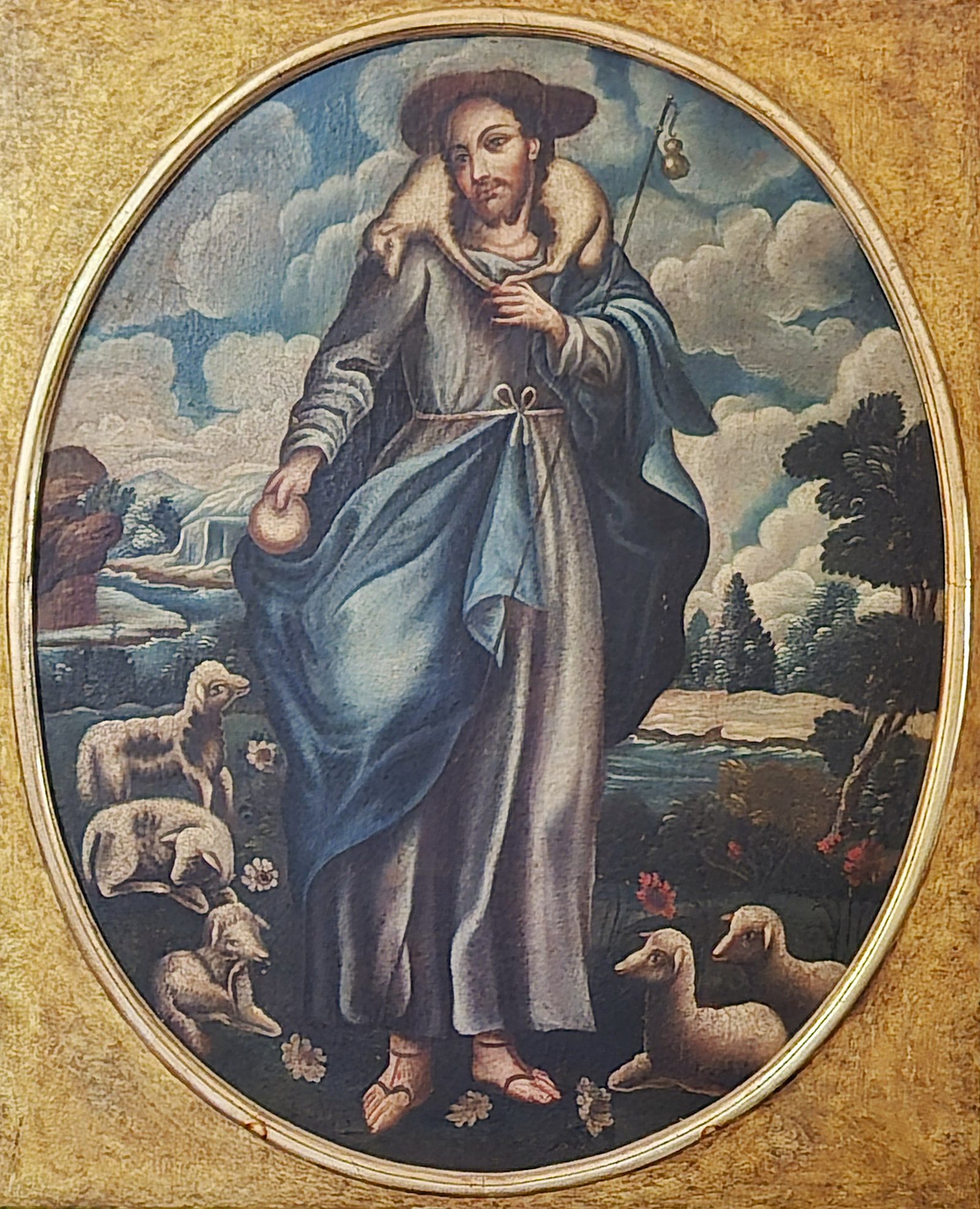
Few religious subjects communicate the tenderness of Christian devotion as immediately as El Divino Pastor. Here, Christ appears not as the distant and triumphant ruler of heaven, but as the humble shepherd who walks among his flock, carrying a lamb upon his shoulders and watching over the sheep gathered peacefully around him.
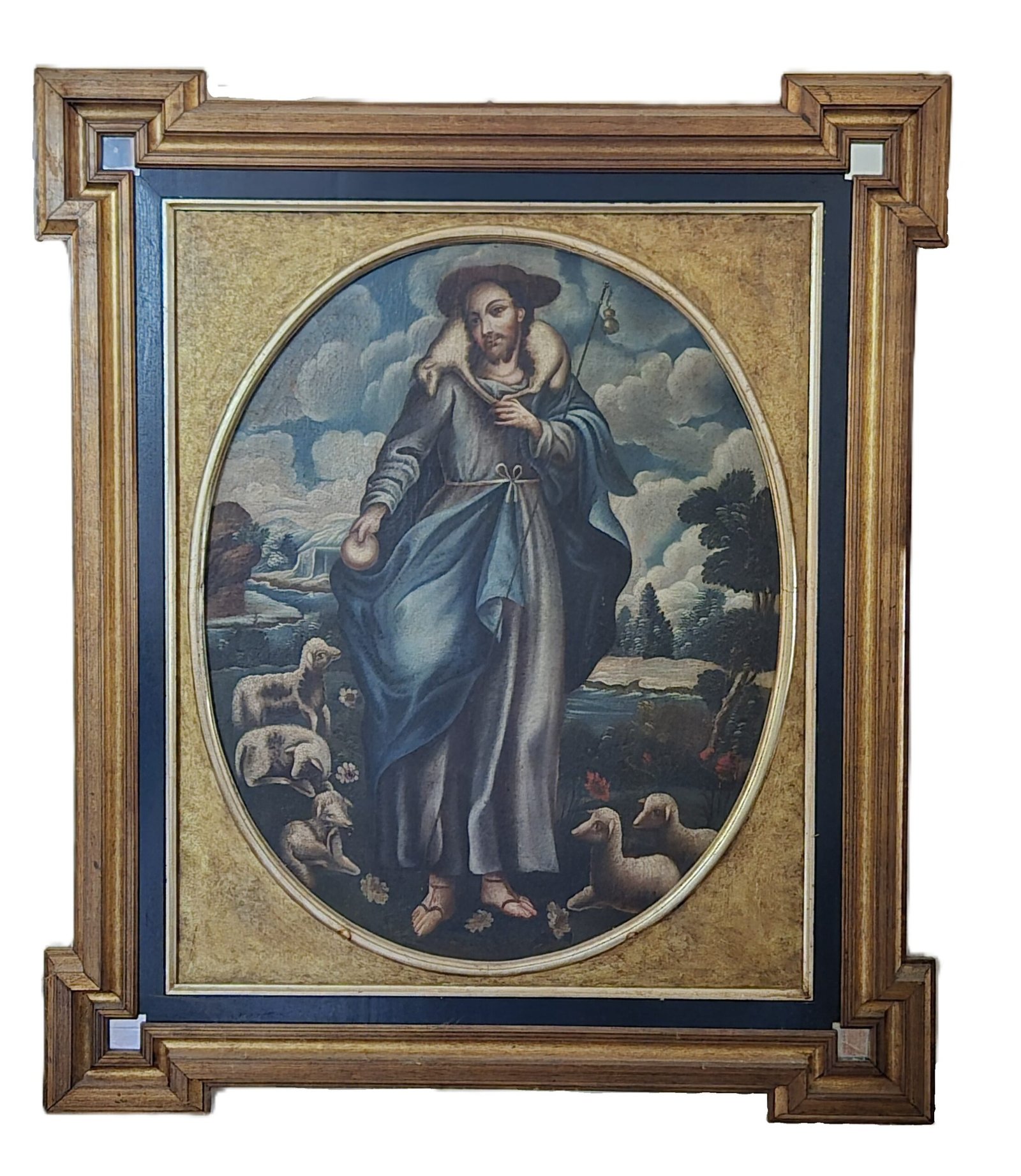
The composition presents Christ standing at the center of a serene pastoral landscape. He wears a long blue-gray robe and a dark mantle, with a broad shepherd's hat and a simple staff. A small vessel or gourd hangs from the staff, as he carries a single lamb on his shoulders, reinforcing his identity as a humble traveler and shepherd. At his feet, several sheep rest among flowers and foliage, while another pair occupies the foreground to the right. Behind him, a stream winds through a wooded landscape toward distant hills and a softly illuminated sky.
The imagery derives from one of Christianity's oldest and most enduring metaphors: Christ as the Good Shepherd who knows, protects and ultimately sacrifices himself for his flock. The lamb carried upon his shoulders evokes the individual soul that has been found and rescued, while the surrounding flock represents the Christian community under his protection. The landscape transforms the theological idea into an intimate, almost idyllic vision of divine care.
In this scene, Christ is offering his flock a loaf of bread in his right hand. The Good Shepherd is not only the shepherd who protects the sheep; Christ is also explicitly the “Bread of Life” in the Gospel of John. There are precedents for combining the Good Shepherd with Eucharistic symbolism. Edward Burne-Jones's The Good Shepherd, for example, incorporates bread and wine into the shepherd's attributes specifically as references to Holy Communion, with the feeding of the sheep reinforcing the pastoral symbolism. Christ carries the lost sheep on his shoulders, protects the flock with his staff, and offers them nourishment with his hand. The subject was particularly important in the art of the Spanish and Spanish-American world. The image of Christ as shepherd circulated widely through paintings, prints, sculpture and devotional objects from the 17th through the 18th centuries. Colonial painters frequently worked from European engravings and established models, adapting them to local tastes and devotional traditions. The theme appears in important works by artists including Bartolomé Esteban Murillo and Cristóbal García Salmerón in Spain, as well as Miguel Cabrera and Antonio de Torres in New Spain. The Museo Nacional del Prado, for example, preserves a monumental 17th-century El Buen Pastor by García Salmerón, while LACMA's collection includes Antonio de Torres's Mexican Divino Pastor, dated 1719.
The present work is unsigned, as is common with devotional paintings from the Colonial period. In religious art of the era, the sacred subject was generally considered more important than the individual identity of the painter, and the emphasis on humility within Christian culture could make conspicuous self-identification seem inappropriate. Consequently, many works produced by colonial workshops remain anonymous today. Rather than diminishing the painting, its anonymity places it within the broader tradition of workshop-based religious production that supplied churches, convents, private chapels and devout households throughout the Spanish world.
From a stylistic standpoint, the painting appears to belong to the broad Spanish Colonial tradition of the 18th century, although its exact place of production cannot be established definitively. The simplified modeling of the figure, expressive facial features, stylized vegetation and animals, atmospheric blue-gray landscape and decorative gold-toned surrounding field are consistent with colonial devotional painting in Spanish America. The work could reasonably be compared with traditions from New Spain and the Andean world, including the Cuzco school, where the Good Shepherd was a recurring subject.
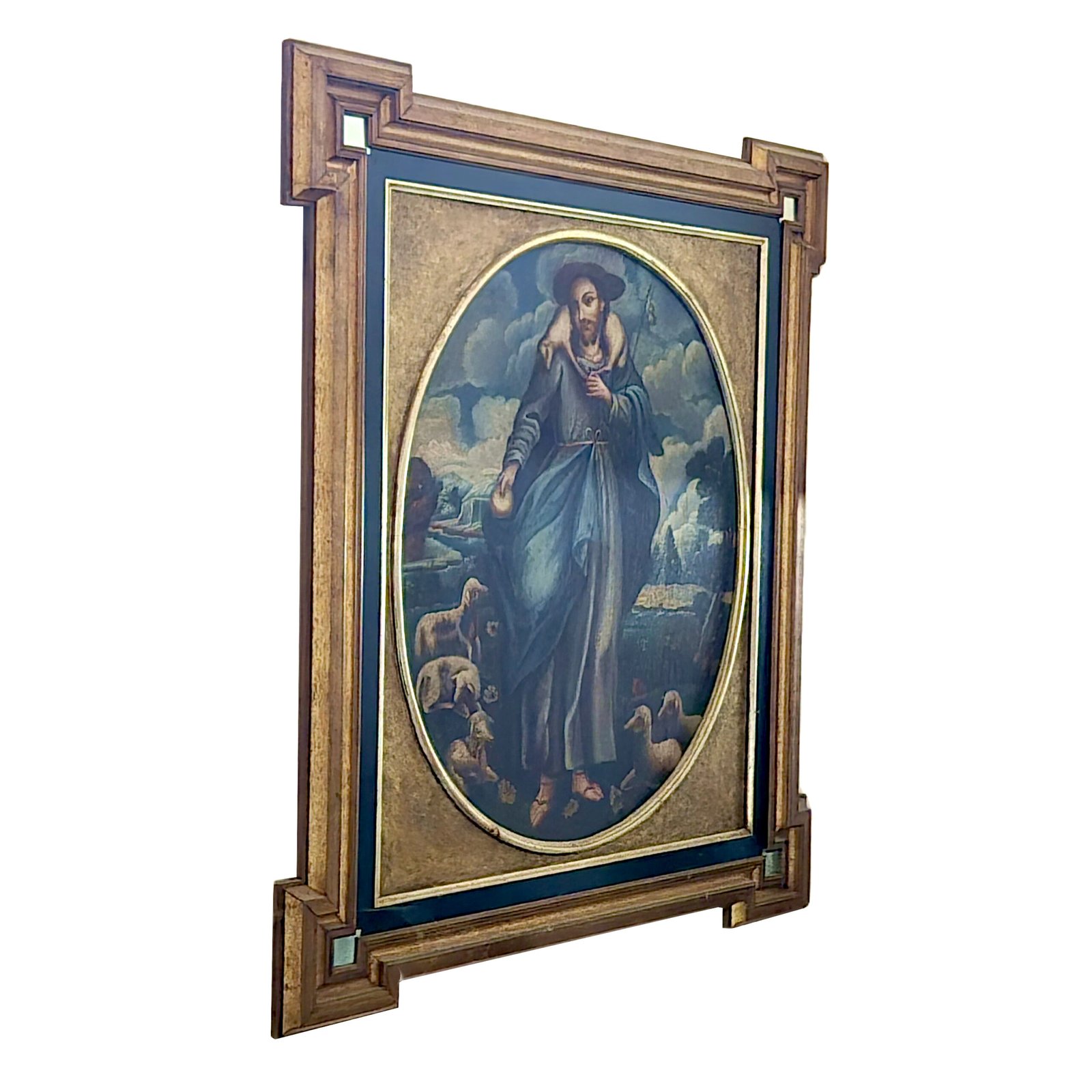
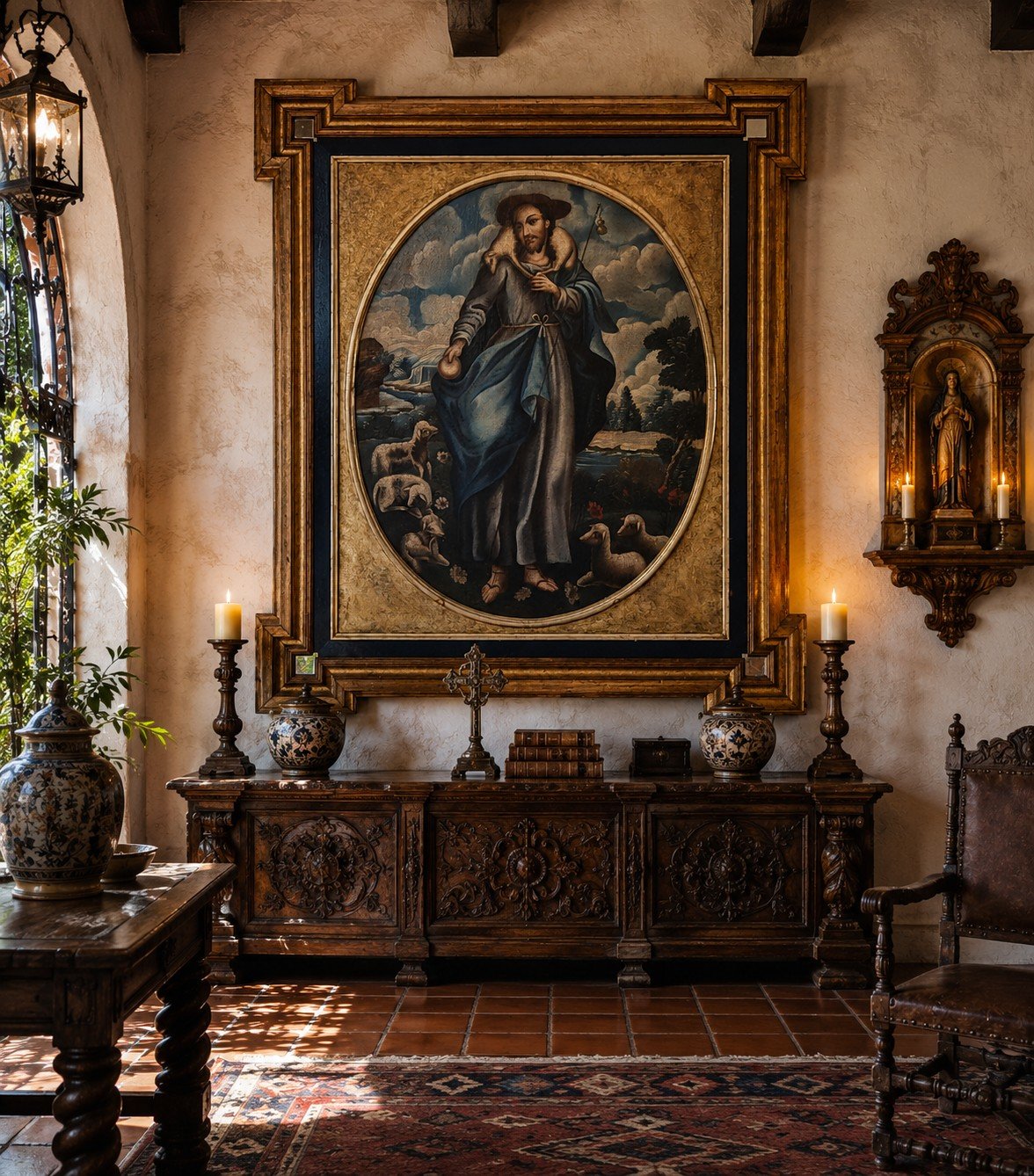
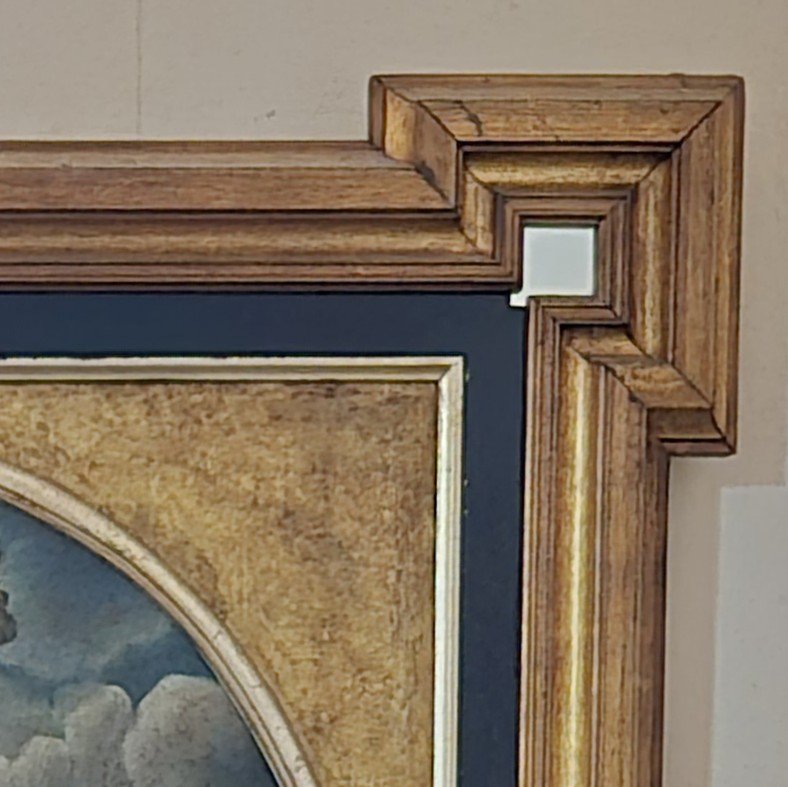
The painting is especially enhanced by its majestic period oval frame, constructed of carved and gilt wood. Its architecture is unusually imposing: broad stepped moldings surround the composition, while decorative square mirror inserts accent the four corners. The combination of gilded wood, dark blue architectural framing and reflective corner details gives the object the character of a devotional altarpiece rather than merely a framed canvas. Such frames are important objects of colonial decorative art in their own right, and elaborate mirror decoration is particularly associated with Spanish-American Baroque interiors. Surviving colonial mirror frames from the Andean world demonstrate the extraordinary value and symbolic importance that reflective glass acquired in colonial religious environments.
At approximately 147 cm (57.9 in.) high × 126 cm (49.6 in.) wide including its frame, this is a genuinely impressive work of wall art. Its nearly five-foot width and almost five-foot height give it the visual authority expected of a painting originally intended to serve as the focal point of a devotional interior. It would be equally compelling above a console in a traditional home, within a private chapel or shrine, or incorporated into a sophisticated collection of Spanish Colonial and Latin American art.
The materials are consistent with traditional colonial painting and framing: oil paint on a canvas support, surrounded by an ornate carved and giltwood period frame with decorative mirror inserts. The surface displays only slight, age-appropriate craquelure in the paint layer. The work is otherwise presented in excellent condition, with the appearance and integrity expected of a devotional painting that has survived for centuries.
Beyond its religious significance, the painting has considerable decorative appeal. Its restrained palette of deep blue, gray, ochre and muted green makes it surprisingly versatile in an interior, while the monumental frame provides an immediate architectural presence. It is the sort of antique that can transform an otherwise ordinary wall into a destination within a room.
For collectors of Spanish Colonial art, religious painting and early Latin American decorative arts, El Divino Pastor offers an especially attractive combination of scale, subject, period character, exceptional presentation and scarcity. Anonymous colonial devotional paintings of this size and in such an imposing frame are increasingly difficult to encounter, making this an opportunity to acquire not simply a religious image, but a substantial historical object with the presence of an antique altarpiece.
Questions or comments
You can email any questions or comments you may have about this treasure. Fill out the contact form and we will reply to you as soon as possible.
- Size: 41-3/4 x 33-1/2"
- Frame: 58 x 49-1/2 x 2-3/4"
- Date / Period: 18th Century
- Style: Colonial
- Material: Oil on canvas


