

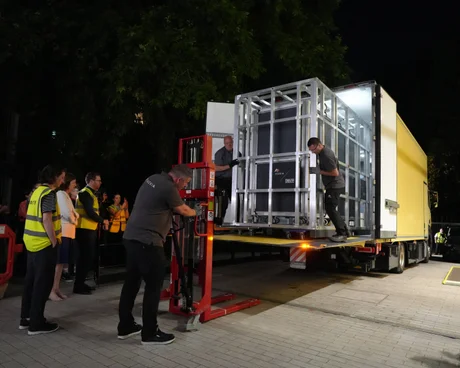
At 3 a.m. on July 10, 2026, a police-escorted convoy carried the famous Bayeux Tapestry to its new display case at the British Museum. The work, 68 meters long and 950 years old, traveled from Bayeux, Normandy, to London in a months-long logistics operation involving governments, museums, and conservation specialists. Throughout history, art has traveled across seas, wars, and continents, and every journey teaches us a lesson about protecting the irreplaceable.
In September 2026, the Bayeux Tapestry went on display in London for the first time. Despite its universal name, the celebrated Bayeux Tapestry is technically an embroidery, not a tapestry. The main difference between a tapestry and an embroidery lies in how the design and the textile structure are built. While in a tapestry the image is born at the same time as the cloth, woven on a loom, in an embroidery the cloth already exists and the image is added on top, stitched with needle and thread. Although strictly speaking in French, tapisserie refers to any decorative wall textile, so the name is not entirely wrong, at least in France. But regardless of its name, this work is no ordinary 11th-century embroidery; it is truly a historical document narrating the Norman conquest of England in 1066. Many consider it the origin of the current British monarchy. The loan, agreed between France and the United Kingdom after years of diplomatic planning, sold out the British Museum's tickets on the first day of sale, making it the biggest box-office day in the museum's history.
England's Birth Certificate
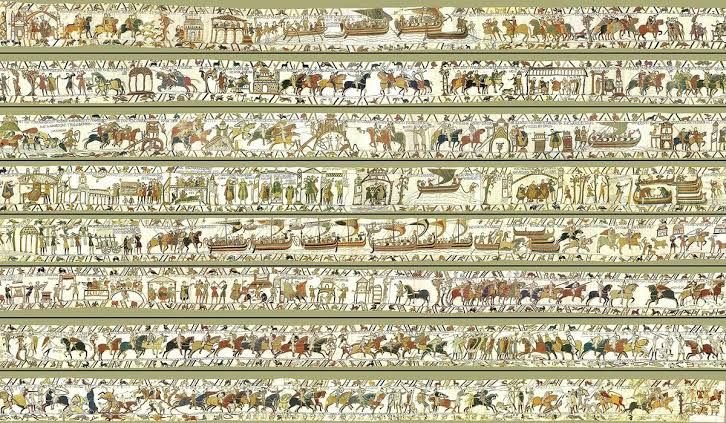
Think about it for a moment: 58 scenes, more than 600 human figures, 200 horses, 41 ships. The embroidery narrates, meter by meter, the story of England's most famous year: 1066, the Battle of Hastings, the fall of Harold Godwinson, the last Anglo-Saxon king, and the coronation of William the Conqueror. For the British, this is the moment their monarchy was born, along with their aristocracy and even their language (words like justice or and liberty crossed the Channel with William). In the British imagination, the tapestry ranks alongside the Crown Jewels.
The tapestry is believed to have been embroidered by the nuns of Canterbury in England, in the highly refined style known as opus anglicanum (English work). So why did it live in France? Because the man who commissioned it was Odo, Bishop of Bayeux and William's half-brother, who wanted it to decorate his cathedral for its consecration in 1077. Since then, apart from two brief stays in Paris, it has remained in Bayeux, today inscribed on UNESCO's Memory of the World Register.
The loan was announced during Emmanuel Macron's state visit in July 2025, and the British Museum sold 100,000 tickets on the first day (more than £2.4 million, a record). The British achieved something they thought impossible: an English masterpiece returns, almost a thousand years later, to the country where it was born. As a gesture of reciprocity, London will lend Normandy treasures from the Anglo-Saxon Sutton Hoo burial.
The Most Delicate Move of the Century
Moving it seemed impossible. A 2020 report documented 24,204 stains, 9,646 gaps in the cloth, and 30 unstabilized tears. For decades, France rejected every loan request with the same diagnosis: too fragile to travel. The solution required completely reinventing how a thousand-year-old textile is moved.
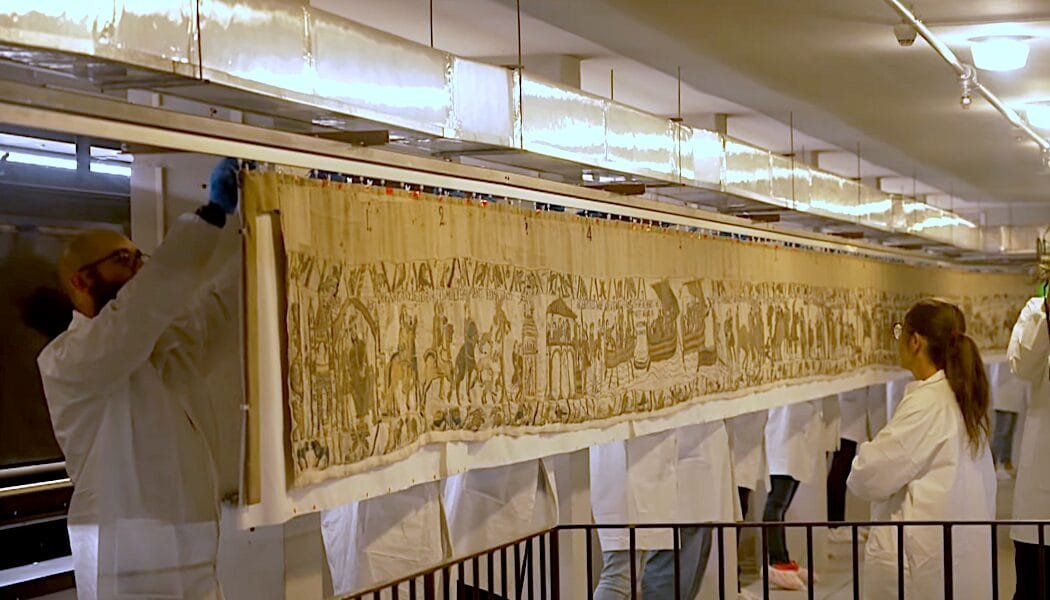
The first step was ruling out the obvious: rolling it up, the standard method for large textiles, was judged the most dangerous option, sheer recklessness for a piece like this. Instead, a hundred people lined up along the 70 meters and moved it centimeter by centimeter (Un, deux, et tac, tac, arrêtuntil it was folded like an accordion onto a collapsible frame, protected between cotton sheets. The whole assembly went into an inner aluminum crate with controlled temperature and humidity (a constant 20 °C), and that crate was housed in an outer cage fitted with 12 metal springs, the kind used in earthquake zones, placed above and below. like a baby in its cradle. The French Minister of Culture described it as a cradle in which a newborn has been laid.
Nothing was left to chance. In February and April 2026, two full rehearsals were run with a replica through the Eurotunnel, measuring vibrations: the crate absorbed 96% of the force of a hard impact, and the Franco-British agreement limited vibrations to 2 millimeters per second. The team drove the road route several times to map every pothole. The operation was "more secretive than a nuclear warhead": tarpaulin fences around the museum, plainclothes police in the village, a bright yellow truck that left Bayeux on July 9 at 6:15 p.m., crossing on the Eurotunnel shuttle train, a handover of escorts at Folkestone, and arrival at the British Museum at 3 a.m. after 11 hours and 560 kilometers, with the Metropolitan Police and Kent Police escorting the final leg. The work traveled insured for 960 million euros, and the operation cost some 20 million. After a week of acclimatization inside its crate, unpacking took 18 hours in a 27-stage process with a hundred French and British restorers.
"Never in the history of art transport have so many tests, so many protocols, so many risk assessments been carried out for a single move," said Minister Catherine Pégard. And British Museum director Nicholas Cullinan offered the sentence that sums up the lesson: much more fragile things travel all the time. much more fragile things travel all the time.
The Same Obsession, on Another Scale
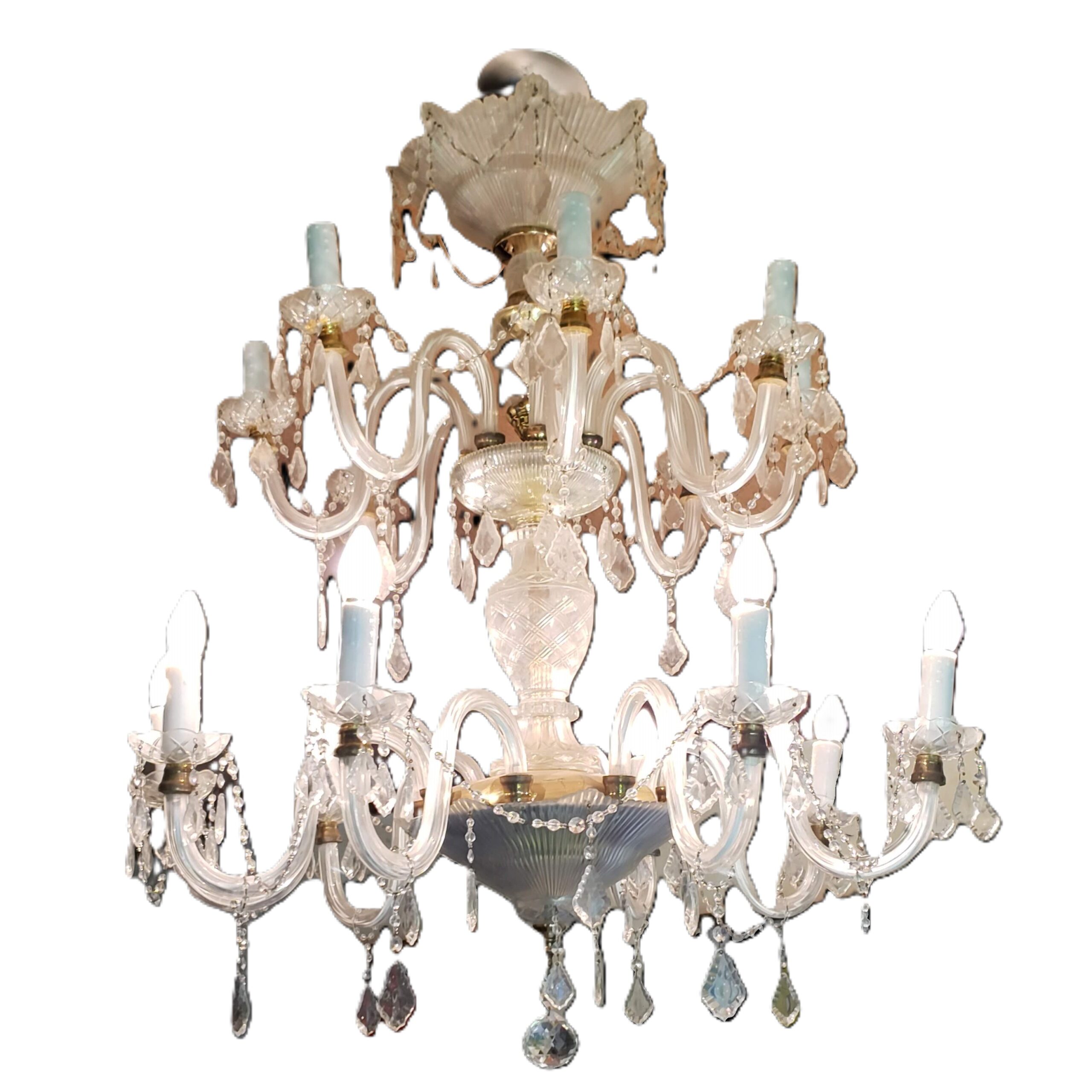
The questions they asked in Bayeux are the same ones we ask ourselves in our gallery with every sale: how to keep each piece perfectly still, how to absorb an unexpected vibration, how to design the inside of the box before thinking about the outside. Our rule is simple: every package must survive a one-meter drop without fear of damage. Our paintings generally travel in custom-made polystyrene boxes (and we replace the frame's glass with acrylic, lighter and safer); sculptures and fragile objects in double-wall cardboard boxes with bubble wrap and cushioning material; and the most delicate pieces, like a 120-centimeter Venetian chandelier with dozens of crystal prisms, travel with specialized movers experienced in transporting art and antiques.
When our customers complete a purchase, that piece is no longer ours: it becomes an object entrusted to our care, with the responsibility of delivering it to its owner in the condition it is in. Whether it is a 950-year-old embroidery crossing the English Channel at 3 a.m. or a piece traveling to your doorstep, the principle is the same: hands that know what they are caring for.
At 32 Reales, that is exactly what we are passionate about: that each piece reaches your hands with its story intact.


