



Composition cinétique
Víctor Vasarely
Silk screen print on paper
21-3/4 x 10-1/2"
Sheet 27-1/4 x 15-1/4"
Frame 27-1/4 x 15-1/4"
Signed
1979
Sold
Description
A work by Victor Vasarely that seems to change shape as we look at it.
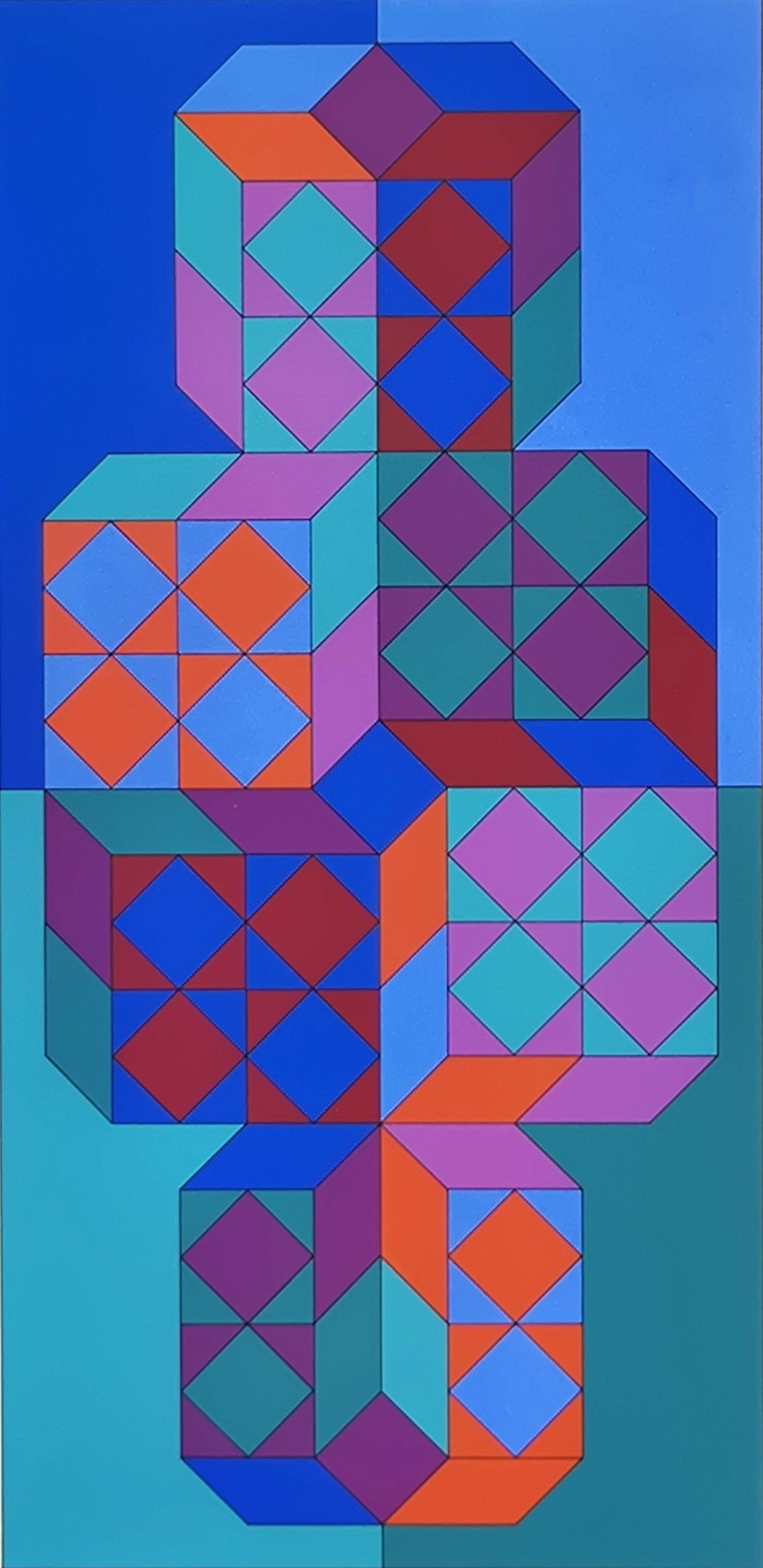
"Composition cinétique" is an extraordinary geometric composition by Victor Vasarely, one of the fundamental artists of 20th-century optical and kinetic art. The work presents a complex vertical structure built from geometric modules - squares, rhombuses, and three-dimensional forms that appear to assemble and disassemble before the viewer's eyes. The intense blues, turquoises, violets, reds, oranges, and greens produce a constant interplay between surface and depth, making a completely flat image take on the appearance of a spatial construction.
The composition is highly representative of Vasarely's artistic thinking. For the artist, geometric forms could function as true visual units capable of combining, repeating, deforming, and reorganizing to produce the sensation of movement. In this case, small square and rhomboidal modules are grouped within larger structures that resemble cubes, prisms, or three-dimensional bodies. The result generates a kind of impossible architecture that extends vertically across the paper.
The viewer can interpret the image as a succession of three-dimensional structures suspended in an abstract space. The forms seem to be connected to one another, although at the same time each section maintains a certain visual independence. This ambiguity is fundamental to Vasarely's language: the artist does not seek to represent a real object, but rather to provoke a perceptual experience in which the eye constantly tries to decide what is in front, what is behind, what protrudes, and what recedes.
This exploration of perception was one of the pillars of Vasarely's work. The Städel Museum explains that the artist systematically studied the relationship between patterns, geometric structures, contrast, color, light, and perception, developing images capable of producing a sensation of depth and movement on two-dimensional surfaces. His work became one of the most recognizable expressions of Op Art and had an enormous influence on graphic design, architecture, and visual culture in the 1960s and 1970s.
Vasarely was born in Pécs, Hungary, in 1906 and developed most of his career in France. His research was related to the Bauhaus, geometric abstraction, and Constructivism, and subsequently led to his particular language of optical-kinetic structures. By the 1970s, he was at the peak of his international recognition. The Städel Museum notes that in 1972 Vasarely was at the highest point of his career and that his work appeared in both exhibitions and architectural and design projects.
Vasarely's importance within 20th-century art extends far beyond painting. His insistence that art could be constructed from systems, modules, and mathematical relationships anticipated many of the concerns of contemporary design. The multiplication of his images through graphic work also allowed his visual language to reach a much wider public. Today, his works are part of important institutional collections, and his production continues to be fundamental to understanding the history of Op Art and kinetic art.
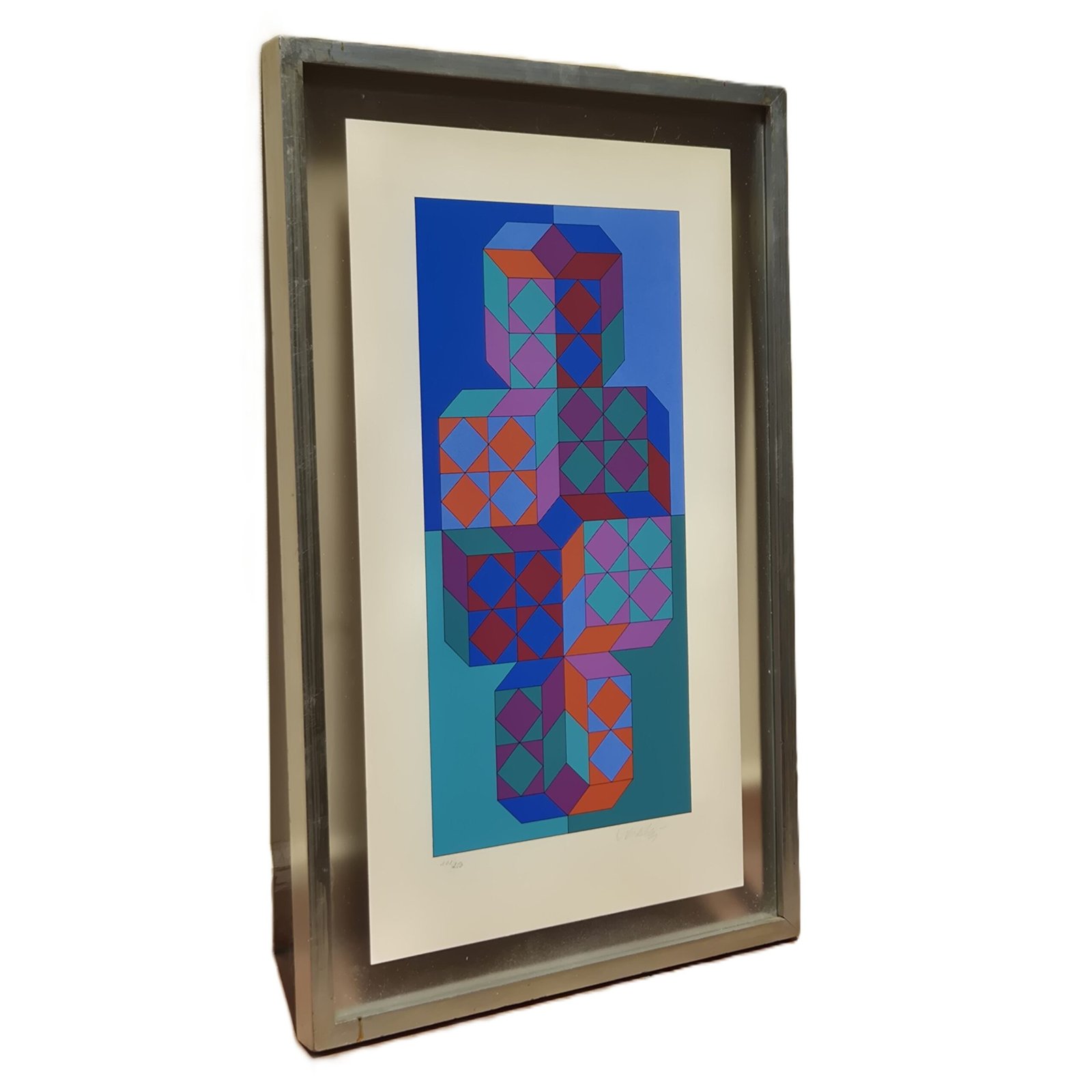
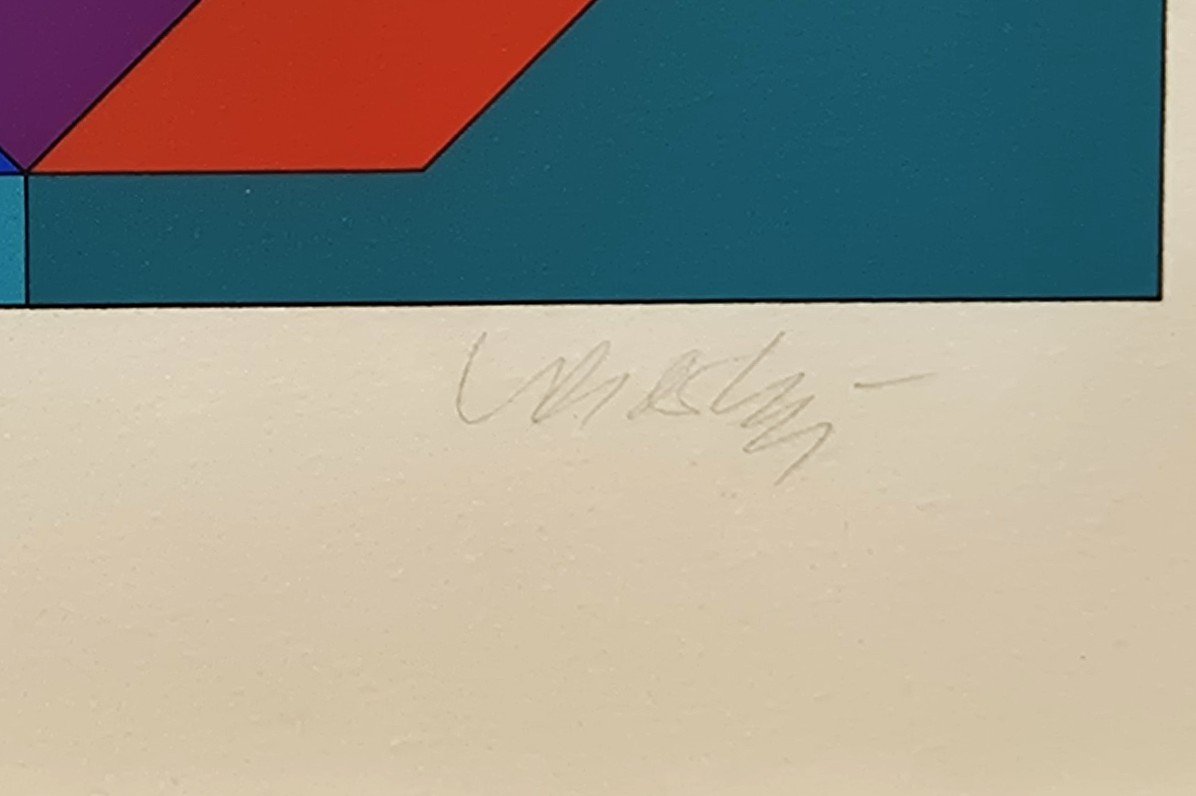
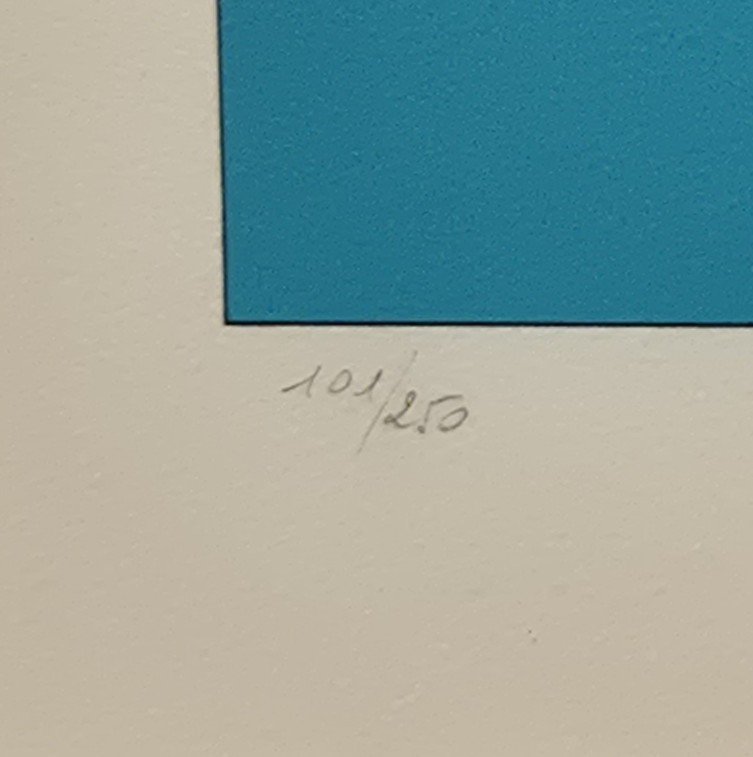
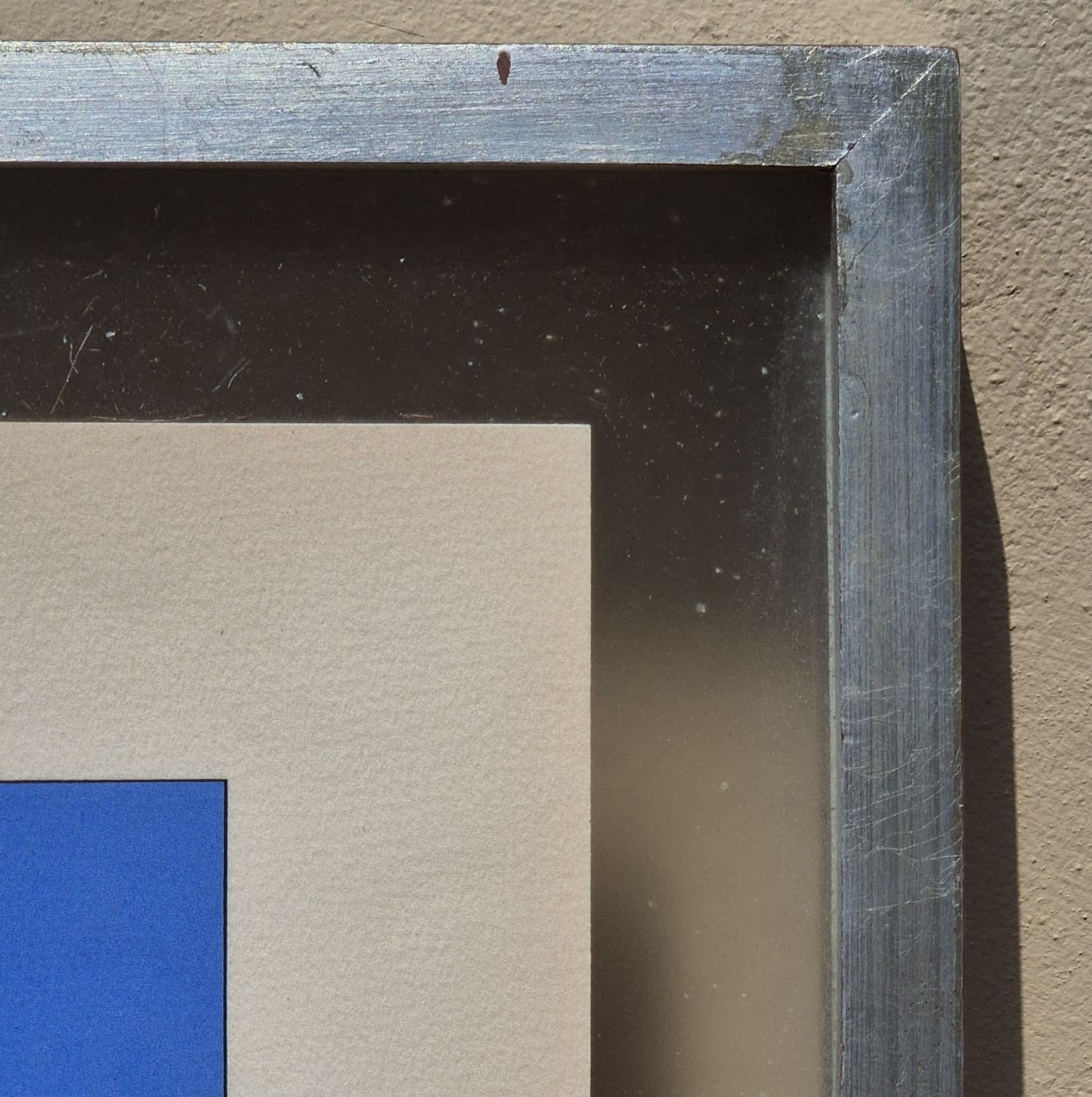
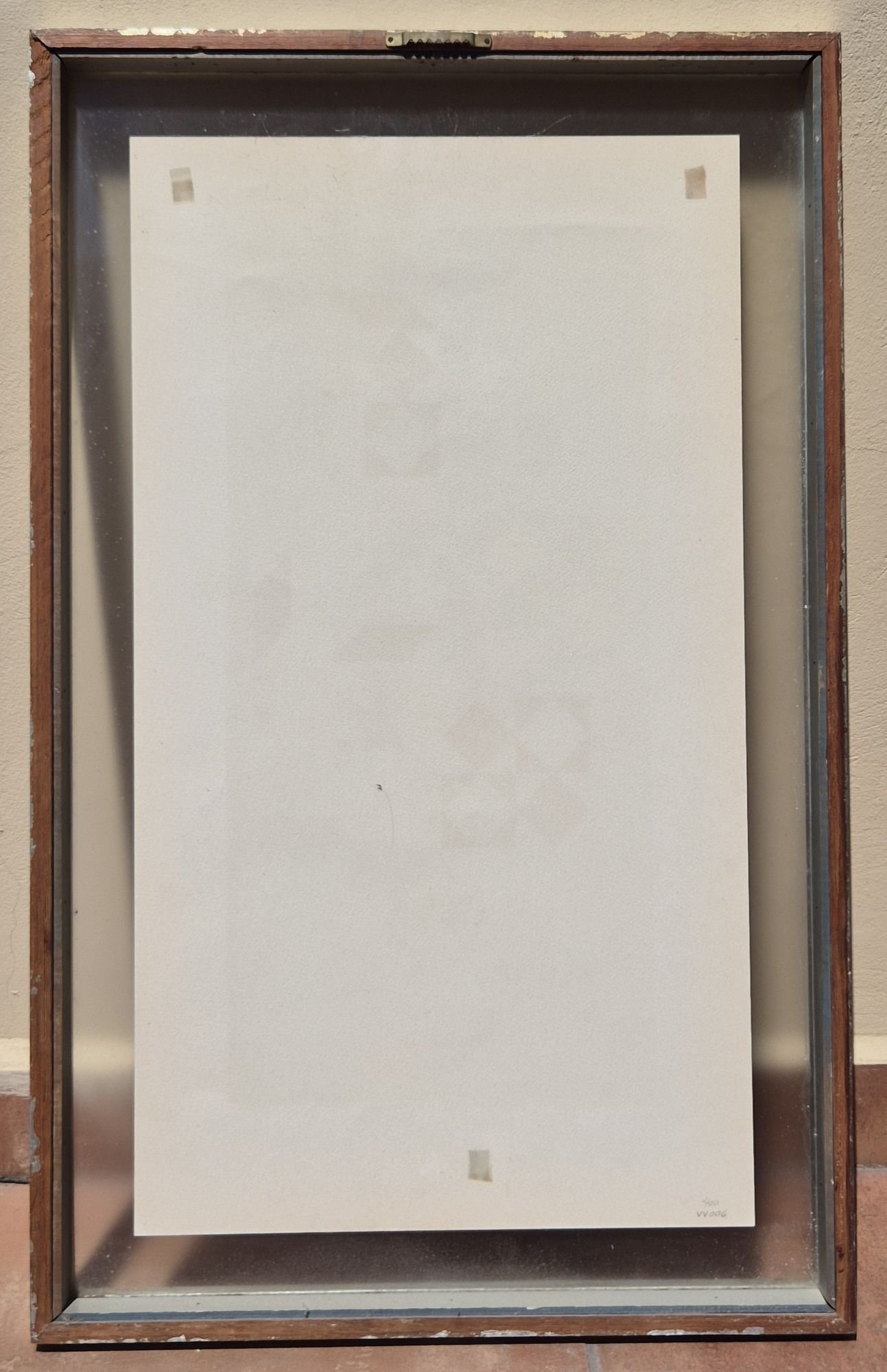
The piece presented here is an original silkscreen on paper. It is signed in pencil by Vasarely in the lower right corner and numbered 101/250. The frame that preserves the piece is original to the period and measures 81.5 x 51 x 3.7 cm. It is in generally good condition and allows the work to be hung immediately. It shows some imperfections and wear typical of its age, particularly on the edges and outer finishes, but these marks do not affect the graphic work or its front presentation in any way. The paper piece is in excellent condition, with intense colors and extraordinary visual presence.
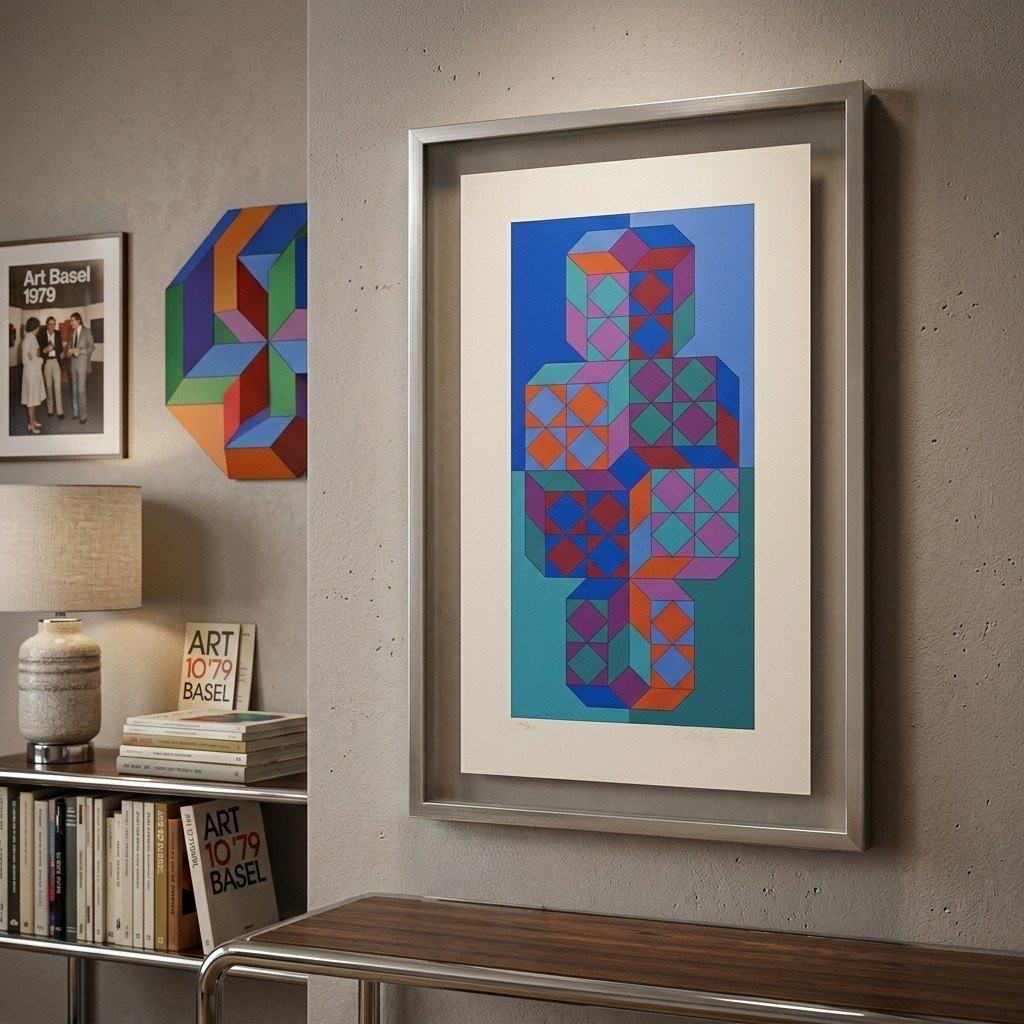
In addition to its aesthetic appeal, this work possesses a particularly interesting historical element: it documents the relationship between one of the main protagonists of Op Art and Art Basel on its tenth edition, at a decisive moment for the fair's international consolidation. Art Basel confirms that in 1979, 88 exhibitors from 24 countries participated, a figure that illustrates the international dimension the fair had achieved barely nine years after its founding.
It is especially interesting because it is reproduced on a poster announcing the tenth edition of the famous fair, held in Basel in 1979. Art Basel had been founded in 1970 by gallerists Ernst Beyeler, Trudl Bruckner, and Balz Hilt, and by 1979 it had already consolidated as an important international platform for modern and contemporary art. The tenth edition also introduced the Perspective sector, a new section intended to present solo exhibitions by artists who were still relatively little known at the time.
Questions or comments
You can email any questions or comments you may have about this treasure. Fill out the contact form and we will reply to you as soon as possible.
- Size: 21-3/4 x 10-1/2"
- Support: 27-1/4 x 15-1/4"
- Frame: 27-1/4 x 15-1/4"
- Date / Period: 1979
- Material: Silk screen print on paper
- Signed: Yes


