

In 2012, a small painting of Jesus Christ in a church in Borja, Spain, became overnight Ecce Homo painted by Elías García Martínez. The result was considerably less biblical and considerably more simian. the Ecce Homo of Borja is far from being the worst restoration disaster that a work
Some interventions have been so bad they provoke laughter. Others provoke tears. And some did something even worse: they eliminated forever original parts of works that had survived for centuries.
These are five of the most scandalous cases.
5. Saint George of Estella: the saint who received a cartoon treatment
If you thought the Ecce Homo was an isolated case, Spain had another surprise in store.
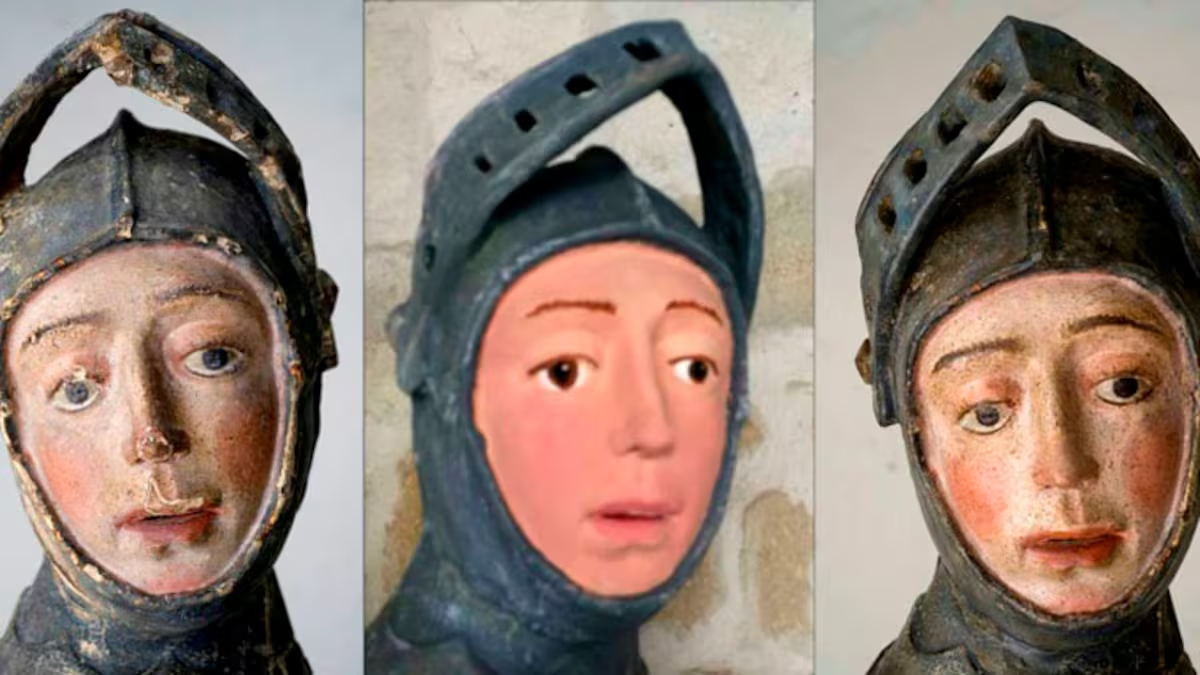
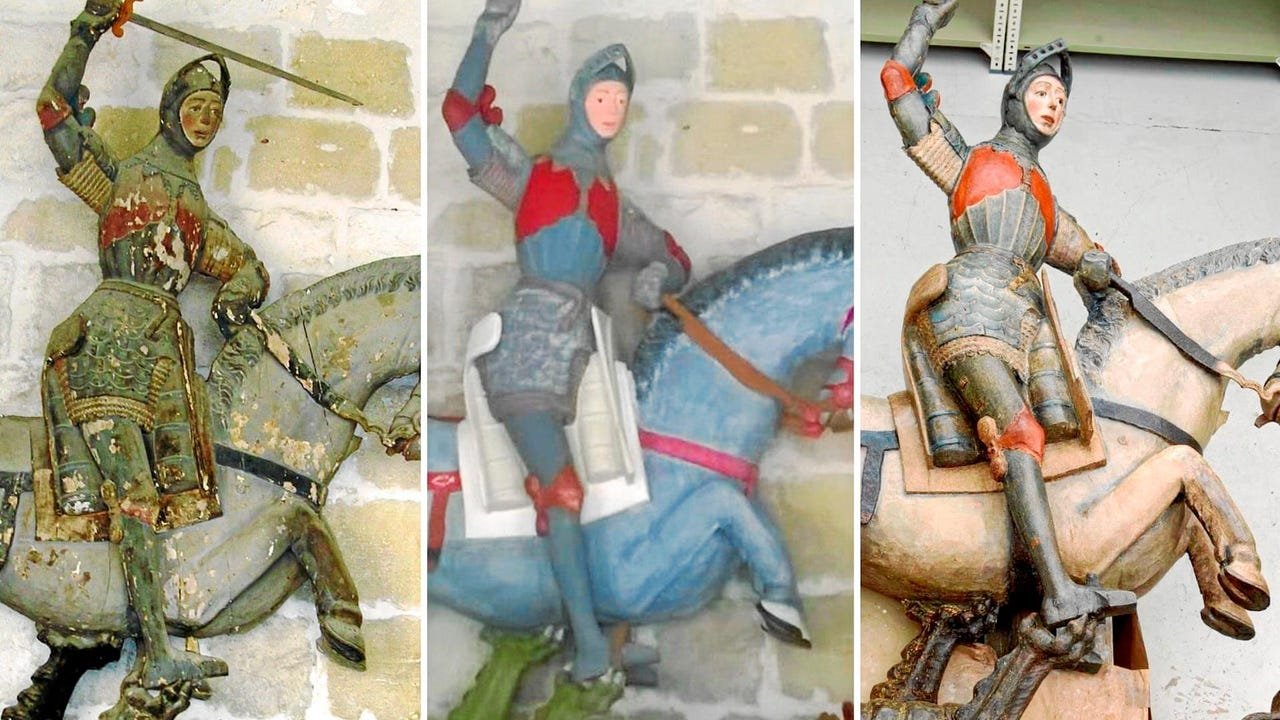
In 2018, an intervention carried out on a 16th-century polychrome carving of Saint George, kept in the church of San Miguel in Estella, Navarra, came to light. The sculpture showed the saint mounted on his horse as he prepared to face the dragon. After the intervention, Saint George looked ready to star in a children's film.
The original polychromy had been covered with acrylic colors applied with little respect for the work. The result was a flat surface, garish colors, and a face with an expression that the Internet compared, among other things, to Tintin.
The joke ended when specialists were able to examine the piece.
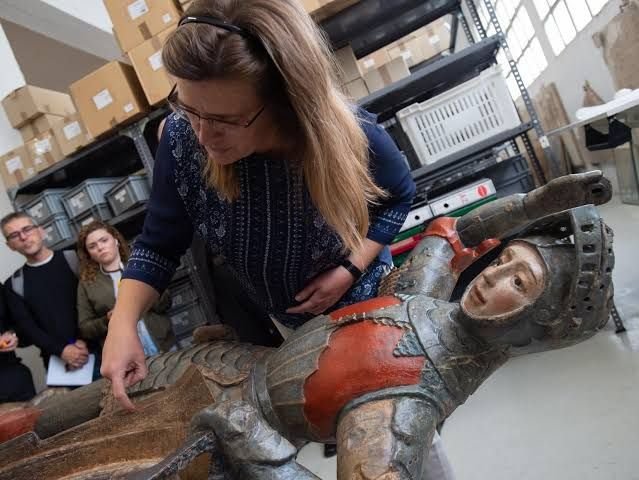
The Government of Navarra determined that the intervention had caused the loss of approximately 45% de la capa pictórica. La restauración profesional posterior costó más de 30,000 euros, mientras que la intervención original se había realizado sin autorización y por un taller de manualidades.
This is where the fun ends.
What is particularly frustrating is that the Government of Navarra had already contemplated a professional restoration of the carving, with an estimated budget of about 8,000 euros. In other words, the disaster could have been avoided.
The moral is quite simple: if a work of historical heritage needs restoration, the solution is probably not to look for the neighbor who paints furniture, the crafts teacher, or the friend who “has a very good hand for painting”.
4. Murillo’s Immaculate Conception: “Who let you do that?”

In 2020, another case appeared in the news that seemed like a parody.
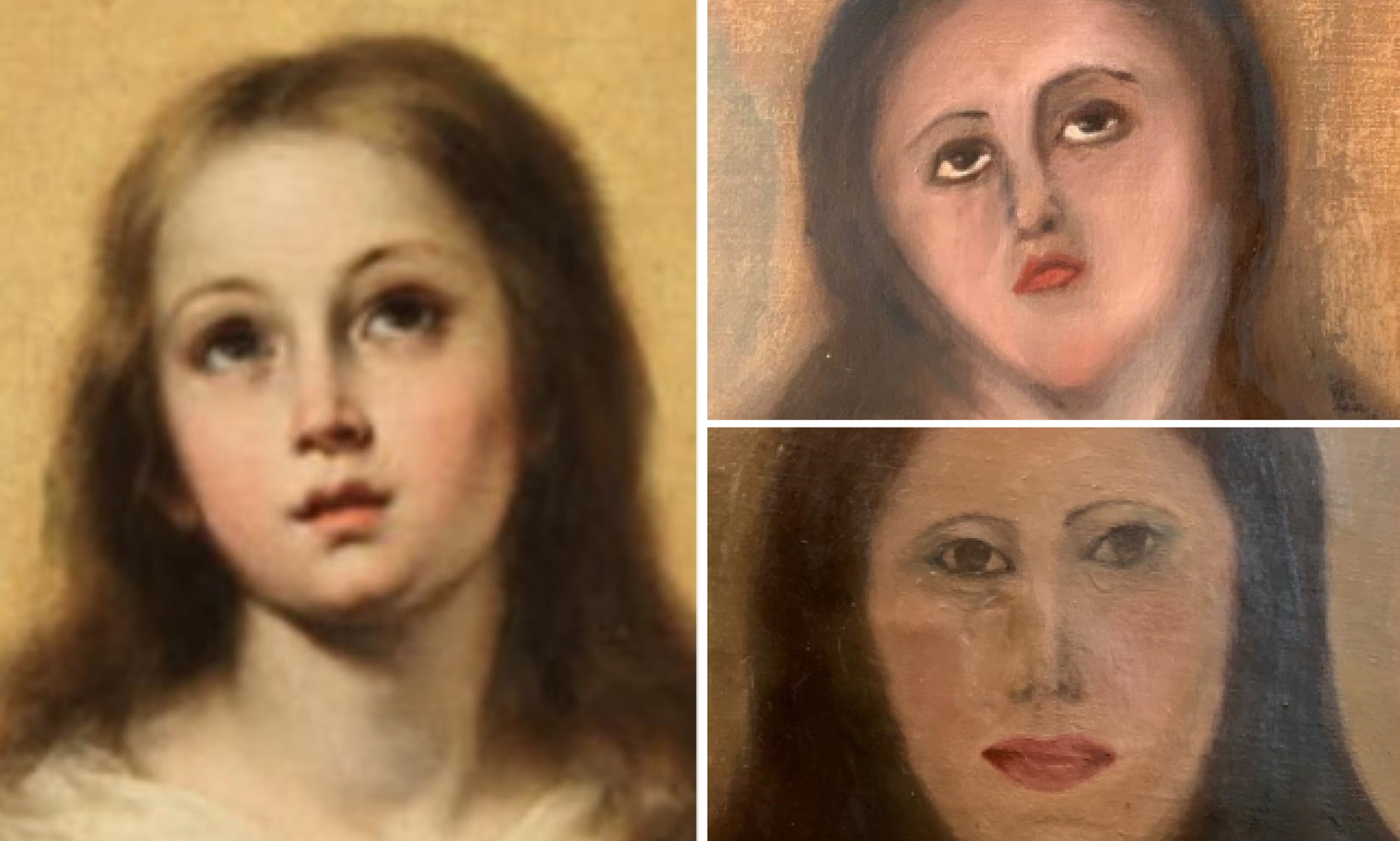
A collector from Valencia brought in a painting that was a copy of a work by Bartolomé Esteban Murillo to be cleaned. The job was entrusted to a furniture restorer.
Yes.
A furniture restorer.
The result was so disastrous that the face of the Virgin was left practically unrecognizable. The owner, naturally, was not satisfied and asked for the work to be corrected.
There was a second attempt.
And, according to reports from the time, the situation ended up even worse. The owner had paid around 1,200 euros for the intervention and ended up with a Virgin that looked like it had been drawn during a particularly difficult elementary school class.
Here it is worth making an important clarification.
The affected painting was a copy of a work by Murillo, not the original conserved in the Prado Museum. That does not mean it lacked value, but it does radically change the historical dimension of the damage.
And speaking of Murillo, there is an even greater irony.
The Prado Museum itself documents how old interventions on its Immaculate Conception of the Venerables had caused real damage: excessive heat during a relining, abrasive cleanings, and repaints that even modified parts of the composition. Modern restoration had to work very carefully to recover the reading of the work without continuing to destroy its original layers.
So, when someone says that restoring is simply "cleaning a painting," remember this case.
Cleaning a work of art can be much more like a surgical operation than like passing Windex over a window.
3. The Parthenon marbles: when cleaning meant erasing history

In this case we leave the territory of restorations that produce memes and enter a rather more painful one.
During 1937 and 1938, several of the Parthenon sculptures conserved in the British Museum were subjected to cleaning procedures that today are considered seriously harmful. Metal brushes and abrasive materials were used to remove dirt and alterations from the surface. The problem was that the surface of the marble was not simply "dirt."
The sculptors had worked the surfaces of the sculptures over centuries, and remains of finish and characteristics that formed part of their material history were still there. The aggressive cleaning removed part of that surface irreversibly. Documents from the British Parliament describe the damage as irreversible in a considerable number of sculptures.
The irony is difficult to ignore. The goal was to conserve the sculptures. To achieve it, part of precisely what was meant to be conserved was removed.
Today the conservation of historical marbles is approached in a radically different way. The British Museum itself explains that its conservators begin by carrying out cleaning tests to find the safest and gentlest possible method, adapting the treatment to each object because each sculpture ages differently.
And that evolution leads us to one of the fundamental rules of modern conservation: before touching a work, you have to understand what you are touching.
2. Piero della Francesca's Nativity: exemplary restoration or a step too far?

Here the story becomes complicated.
Because if the Ecce Homo of Borja allows us to laugh at a restoration that went spectacularly wrong, The Nativity Piero della Francesca's Nativity forces us to ask ourselves a much more uncomfortable question:
What happens when a professional restoration, carried out with scientific studies and years of work, tries to repair something that is already impossible to recover?
Piero della Francesca painted The Nativity at the beginning of the 1480s, probably for his own family's palace in Sansepolcro, Tuscany. For centuries it remained in the hands of the family and reached London in the 19th century in a rather pitiful state. The panel was divided, there were losses of paint, and some areas had suffered such aggressive cleaning that the faces of the two shepherds had been practically erased.

For a long time, the state of the painting produced an interpretation that today seems quite likely to have been mistaken: it was thought that Piero had left the work unfinished.
The theory had a certain logic. Some figures seemed incomplete, and the absence of shadows on the characters gave the scene a strange, almost ghostly appearance.
But documents discovered in 1992 radically changed the discussion. An inventory made shortly after Piero's death describes the painting installed in a room of the family house and makes no reference to its being unfinished. The National Gallery currently maintains that it was a finished work and that much of what seemed "unfinished" was in fact the consequence of later damage.
Between 2019 and 2022, the National Gallery carried out a complex treatment directed by its chief restorer, Jill Dunkerton, with structural work by Britta New. The project had an ambitious goal: to recover the reading of a painting that had been deformed by centuries of deterioration and previous interventions.
The National Gallery considers that the result allowed it to recover much of Piero's original intention.
The team found, for example, that a shepherd points toward a illuminated area of the stable wall. The cleaning and reintegration of that area made it possible to interpret the light better as a supernatural element related to Saint Bridget of Sweden's vision of the birth of Christ. A greater sense of depth and space in the composition was also recovered.

Up to here, it seems like a success story. But then the critics arrived. And some were quite harsh.
The art critic Jonathan Jones, of The Guardian, considered that the National Gallery had gone too far. His main objection was about the two shepherds. Since their original faces had been destroyed by an earlier cleaning, the restorers used Piero's underlying drawing and the surviving evidence to partially reintegrate the figures. For Jones, this crossed an important line.
In his opinion, the new faces looked artificial and distracted from the original painting. He also questioned the decision to make a luminous area of the stable wall much more visible, arguing that the National Gallery was physically incorporating into the painting a specific interpretation of its religious meaning.
Are we seeing a restoration or a reconstruction?
The difference may seem small, but for heritage conservation it is enormous.
The National Gallery maintains that the reintegrations were carried out using very thin and controlled layers, following the original drawing that could still be studied beneath the losses. In its documentation, the restorer Jill Dunkerton acknowledges that it is a compromise: the damaged areas could not simply be left as they were because the large white areas of plaster interrupted the composition, but neither could they be freely reconstructed. That is why the reintegrations were deliberately limited and, according to the institution itself, reversible. Other specialists and critics, however, consider that precisely those areas should have been left visible.
Because there is a fascinating paradox here: damage is also part of the history of the work.
If a 15th-century face disappeared long ago, should we try to imagine how it might have looked? Or should we accept that that face is already lost and let the viewer see the scar? There is no universal answer.
In fact, the controversy was not simply a reaction from people who found the new faces "ugly." The criticism raised a much deeper question: to what extent a restorer can intervene when the original information no longer exists sufficiently.
And there were critics who defended the intervention.
Waldemar Januszczak, for example, argued that the shepherds had been practically erased by a bad old cleaning and that the restoration allowed their function within the composition to be recovered. For him, the recovered figures and the light on the wall helped to understand the structure and meaning of the work.
The fact that a restoration is technically sophisticated does not mean that all its decisions are indisputable.
What would you have done? Would you have preferred to leave the shepherds' faces as they were, conserving the original losses, or do you think the restoration did well to give them back a visual presence using the evidence that still remained? Are we seeing a defect that should disappear, or are we seeing part of the history that makes that work unrepeatable?
1. The Ecce Homo of Borja: when Jesus ended up looking like a monkey
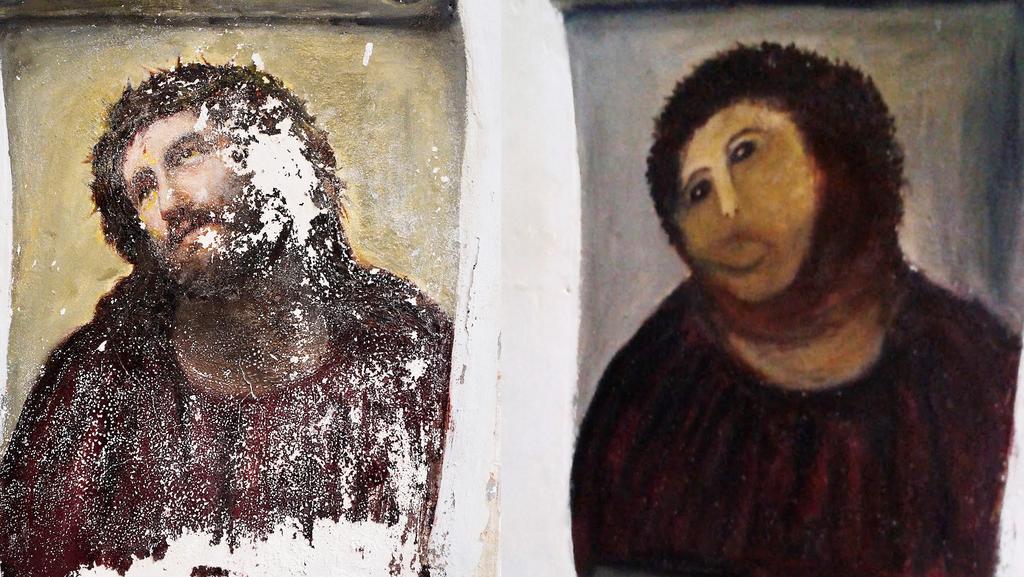
And in first place, the case that probably all of us have seen at some point.
The Ecce Homo by Elías García Martínez was a small mural painting made around 1930 in the Sanctuary of Mercy in Borja, Spain. It was not exactly a masterpiece of the Renaissance. In fact, its artistic importance was relatively modest.
Its deterioration, however, was evident.
In 2012, Cecilia Giménez, an 81-year-old painting enthusiast, decided to intervene in the image. As she later explained, she was trying to repair the deteriorated areas of the painting and her work was still unfinished when the news began to circulate.
Then the Internet did internet things.
The face of Christ had been left practically unrecognizable. Within hours, photographs of the intervention went around the world and comparisons began with a monkey, a bear, and even a potato in a tunic.
The press baptized the result as “Ecce Mono”.
The curious thing is that the story ended up taking a completely unexpected turn. The work became a tourist attraction and the small town of Borja began to receive visitors interested precisely in contemplating the failed restoration.
The lesson, however, is much more serious than the joke.
A restoration is not an opportunity to repaint a work according to what we believe it should look like. The goal is to conserve and recover, as far as possible, the information that still exists in the original.
In Borja, the accidental restoration ended up creating a new work with a new story. The problem is that nobody asked the poor Ecce Homo to reinvent itself.
So, should we never restore a work of art?
Restoring a work of art can be absolutely necessary. A painting can have structural problems, detachments, humidity, insect attacks, oxidation of materials, cracks, or conditions that directly threaten its survival.
The problem begins when we confuse conserving with with beautifying..
Contemporary restoration starts from a much more prudent idea: intervene only as strictly necessary, document the process, and use methods that allow, when possible, a future intervention to be removed or modified without destroying the original.
That is why reversible techniques or, more precisely, treatments that allow future intervention and minimize the impact on original materials are so important.
There is also another fundamental principle: visually distinguish between what is original and what has been reintegrated. The restorer should not become the new artist of the work.
The goal is for the viewer to understand the piece, not for someone to win a "before and after" contest.
Our opinion at 32 Reales
At 32 Reales we believe that an old work should preserve, whenever possible, the traces of its history.
A crack, a small loss of paint, a controlled oxidation, or a natural patina are not necessarily defects that should disappear. In many cases they are part of the authenticity and the material history of the piece.
Our position is simple: if a work is stable and its damage does not put its integrity at risk, we prefer to leave it in the state in which it has reached us.
When there is a problem that does threaten the survival of the piece, the situation changes.
In those cases, restoration may be necessary and must be carried out with the greatest respect for the original materials, using studied, documented, and the least invasive techniques possible.
At 32 Reales we have trained personnel, with studies and experience in conservation and restoration, to handle this type of situation with that criterion.
Because after all, a restoration should have a rather modest goal:
that in a hundred years someone can still see the work that we were lucky enough to find.
And if at the end of the job the saint still looks like a saint, the Virgin still looks like a Virgin, and Jesus still looks like Jesus, we are probably on the right track.


