

One day before the auction that promised to break the record for the highest price ever paid for a Van Gogh, a letter arrived that almost stopped the sale. The heirs of Samuel Fischer, the Berlin publisher who had bought Châtaigniers en fleurs in 1909, wrote to Sotheby's on November 12, 2026. The letter said the family had sold the Van Gogh in 1936 under the pressure of Nazi persecution, and asked the prestigious auction house to withdraw the lot to make a formal restitution claim. Sotheby's did not withdraw the lot. On Tuesday, November 17, the two families announced a a mutually satisfactory resolution, with the terms kept secret, and the auction went ahead the next day.
The painting sold. The question, however, remains open, and it is not only about this Van Gogh. It is about thousands of works that changed hands between 1933 and 1945, and about what is owed today to the families who lost them.
The 1936 Sale, Step by Step

The provenance history of this painting is documented in uncommon detail, and still does not settle the question. Van Gogh painted Châtaigniers en fleurs in May 1890, in Auvers-sur-Oise, in the last weeks of his life. Samuel Fischer, founder of the publishing house S. Fischer Verlag, acquired it in 1909. In 1932 or 1933, the painting was deposited with the firm Paul Cassirer and Co. in Amsterdam. In 1934, Brigitte and Gottfried Bermann-Fischer inherited it. About three months before the sale, they fled Berlin to 68,000 Swiss francs, about $22,000 at the time, on behalf of the Bermann-Fischers. Decades later, in 1975, the Argentine couple Carlos Pedro Blaquier and Nelly Arrieta de Blaquier bought it from the Wildenstein gallery in New York, and it remained out of public view for almost half a century.
The Fischer heirs read that chain of events as a forced sale. Their publishing business had been damaged by the regime: banned authors, burned books, and the Reich flight tax that taxed the property of those who emigrated. Selling, they say, was not a free decision, but the way to get out alive and with some money. Their claim rested on the Washington Principles of 1998, eleven non-binding guidelines, agreed by 44 governments, calling for identifying art confiscated by the Nazis, opening the archives, and seeking a just and fair solution when the owners or their heirs can be identified.
Sotheby's reads the same chain of events differently. Its investigation, according to the house, has not established that the sale was made under duress or below market price. And it adds a fact that carries weight in its reading: after the war, the Fischers sought the return of works lost in a forced sale in 1938, and the Van Gogh was not on that list. For the house, that suggests the family did not then consider this sale a loss caused by persecution.
Both readings fit the same documents. That is why the November 17 agreement resolved nothing about what happened in 1936. It resolved the practical matter: the auction could go ahead and the buyer would receive a clean title. The terms remained secret, and the question of whether there was coercion was left without an official answer.
Theft and Forced Sale Are Not the Same Thing, and That Complicates Everything

A theft is simple: someone enters, takes the work, and leaves with it. No one disputes that this is a wrong that must be put right. A forced sale is harder. There is a contract, a price, a signature. What may be missing is free will. The freedom with which a person closes the deal is hard to prove, all the more so once ninety years have passed, the witnesses are gone, and the archives have gaps.
The Fischer case is the difficult case par excellence, and that is why it matters. In 1936, the Netherlands was not yet occupied and Vienna had not yet been annexed. Persecution already existed in Germany, but the sale was made from Amsterdam to buyers in Paris, through a respectable art house. Is the regime's general pressure enough to say that a particular sale was forced? Or must it be proven that the price was unfair or that the family had no other option?
The Washington Principles are a set of non-binding guidelines adopted in 1998 to facilitate the identification and restitution of works of art confiscated by the Nazi regime between 1933 and 1945. These rules promote opening historical archives, creating central registries, and seeking just solutions for former owners or their heirs. Although in theory they are a good idea, they require honesty from both sides and do not provide an automatic answer. Finding a just solution depends on the good faith of those negotiating and on their willingness to share information that could harm them.
The other side of the coin is also real. Selling a work from a collection is never done for pleasure: whoever sells does so because they need liquidity, and there is no pleasure in parting with something that was collected. The difference is not between selling under pressure and selling for pleasure, but in the nature of the need: selling to start a business or send the children to university is not the same as selling to escape a regime that is persecuting you. But the line between one need and another is not always clear.
To the Victor Go the Spoils
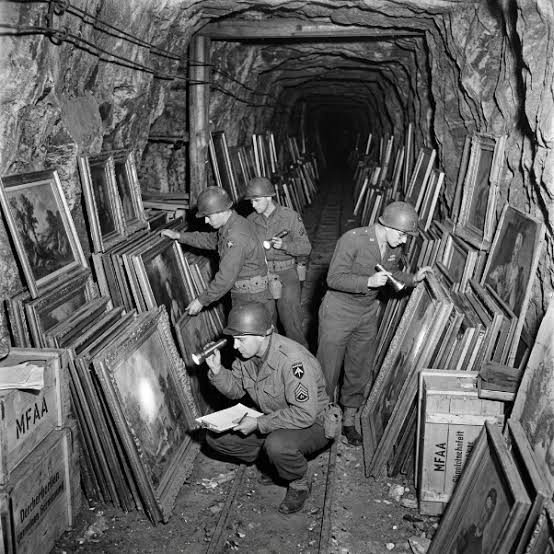
The history of stolen art did not begin in 1933. Long before that, victors took the treasures of the defeated as a natural part of victory. The Etruscans, the Egyptians, the Romans, the Vikings, and the Christian colonial powers looted cities and temples, and the works ended up in palaces, churches, and museums thousands of kilometers from their origin. For centuries, no one asked where a piece came from. Asking was almost bad manners.
Today we ask, and the question has no simple answer. Returning all stolen treasure to its rightful owners is a virtuous idea, but in practice it is impossible. Who decides who the rightful owner is after ninety years, five good-faith owners, and several generations? What happens to works whose origin has been lost, or that were bought in good faith by someone who knew nothing? And what about the museums that have cared for, studied, and displayed them for decades? The question is not whether they should be returned, but how, and to whom, and with what evidence.
That does not mean nothing should be done. It means each case is resolved separately, with provenance research, negotiation, and sometimes a court. And it means restitution is not always returning the work. Sometimes it is a financial agreement, sometimes a plaque telling the story, sometimes a long-term loan. Justice, in these cases, rarely arrives in the form of a clean return.
Restitution Is Still Being Decided Today

November 2026 provided two examples of how alive this issue is. On November 9, the Von der Heydt Museum in Wuppertal announced the return of Paradiesvögel, by Max Slevogt, to the heirs of Eduard Fuchs. The provenance research had classified its 1937 auction as a loss caused by Nazi persecution: the Gestapo had confiscated part of Fuchs's collection between 1933 and 1935. That the work had passed through a public auction, with a lot number and a buyer, did not make the sale ordinary. The museum returned the work.

Four days earlier, on November 5, a Paris court annulled the sale at Sotheby's London, in June 2024, of a 1902 Pissarro, and ordered it returned to the heirs of Salomon Flavian, whose collection was seized in occupied Paris in 1941. The catalogue said the work was offered under an agreement with the heirs, but only two family members had signed it. The court did not accept that agreement. An agreement, the ruling seems to say, is not valid if it is not signed by those entitled to claim.
The two cases look at the Fischer case from opposite angles. The Wuppertal one says a sale that looks formal can be a loss caused by persecution. The Paris one says an agreement resolves nothing if it does not include all the heirs. The Fischer agreement, with its terms secret, sits between those two lessons: it resolved the auction, but it did not resolve the history.
What the Agreement Achieved and What It Left Open
The November 17 agreement achieved three concrete things. First, it recognized that the Fischer family had a claim worth hearing, even though Sotheby's did not accept that there had been coercion. Second, it gave the buyer a clean title, without the risk of a future lawsuit over this work. Third, it allowed the auction to take place and the painting to be seen again, even if only in photographs and headlines, after half a century hidden away.
What it left open is just as concrete. It did not establish whether the 1936 sale was forced. It created no precedent for other cases, because its terms are secret. And it did not answer the underlying question: when a family sells under the shadow of a regime that is persecuting it, who has to prove what? The family, which must prove coercion with ninety-year-old papers, or the party defending the sale, which must show it would have happened the same way without the regime?
The Van Gogh sold on Wednesday, November 18, for $165 million hammer, $190.40 million including commissions, a record for the artist, and it was bought by dealer Bill Acquavella. It is a figure that will fill the headlines. But the figure is not the whole story. The story is the letter of November 12, the June 1936 sale, and the two families who, ninety years later, had to sit down and negotiate what that sale meant. Stolen art and art sold under duress will remain in the courts and in museums for years. The one certainty is that every work that reappears brings its provenance with it, and that provenance, sooner or later, demands an answer.


