

World history is full of figures who paved the way so that others could take the applause. Facebook was the idea of the Winklevoss twins, and before them Tom from MySpace, but the world credits Mark Zuckerberg as its inventor. Brothers Mac and Dick McDonald created the restaurant that bears their name, but Ray Kroc is the one everyone remembers as its founder. Nikola Tesla watched Guglielmo Marconi be crowned inventor of the radio, and Thomas Edison copied everything he could from the Serbian-American inventor. And speaking of Tesla, how could we not mention Elon Musk, who is known as the creator of PayPal and Tesla, when in reality he founded neither one. Well, at the end of the nineteenth century, in the Mexican capital, a case just as momentous, though much less well known, took place.
Before Posada, There Was a Manilla
When we think of Mexican calaveras, the name of José Guadalupe Posada comes to mind almost automatically. His work appears in history books, his images circulate every Day of the Dead, and his famous Calavera Garbancera, popularly renamed La Catrina, has become a kind of worldwide ambassador for death, Mexican style.
Manuel Manilla (around 1830-1895, died of typhus in 1895), on the other hand, was an engraver who, like Posada, worked illustrating printed matter from the mid to late nineteenth century in Mexico. We know much less about his life than about his artistic output, but his work makes it possible to reconstruct a fundamental part of the history of Mexican popular graphic art. His earliest recorded prints date from 1873, in the popular publication La edad feliz.
Manilla worked for the printing house of Antonio Vanegas Arroyo, one of the most important publishers in late nineteenth-century Mexico. Years before Posada arrived in Mexico City, Manilla was already producing illustrations for inexpensive publications aimed at a broad public: broadsheets, stories, songbooks, corridos, and accounts of extraordinary events. The images had to communicate quickly, catch the attention of passersby, and accompany stories that could be sold for just a few cents.
In that world, Manilla found in skeletons an extraordinary resource.
Death Had Plenty of Work in Nineteenth-Century Mexico
To understand Manilla's importance, you have to imagine Mexico in those years. The popular press mixed news, satire, religion, entertainment, and moral warnings. In that world, the calavera could do much more than remind us of our mortality: it served to mock customs, ridicule social pretensions, and represent human situations without the limitations of drawing characters of flesh and blood.
A skeleton could be a bullfighter, a drunk, a politician, an aristocrat, or any neighbor convinced that his personal importance would keep him safe from fate. The humor lay precisely in that. Faced with death, everyone ended up turned to bone, and the calavera displayed that universal equality with humor, irony, and a healthy dose of irreverence. Manilla turned death into a character, a satirical resource, and the protagonist of scenes inspired by the society of his time.
The calaveras did not come from nowhere: they came from a long tradition of representations of death, religious practices, satirical literature, and popular publications. Manilla's contribution was to turn that repertoire into a graphic language that was accessible, everyday, and profoundly Mexican.
In the publishing world of that era, engravers were not considered artists. There is no need to imagine him working in a solemn studio, waiting for divine inspiration. He probably had commissions to deliver, deadlines to meet, and an editor who needed images to sell. Popular art also has its delivery dates.
Vanegas Arroyo: The Man Who Put the Images Into Circulation
In this story there is a third figure who deserves recognition: Antonio Vanegas Arroyo. His printing house was one of the great engines of Mexican popular print culture. Under his imprint circulated texts and images that shaped the imagination of several generations. In his workshops, illustrators, engravers, and writers collaborated, and today we know them unevenly, in part because publications tended to highlight the publisher's name and many images lacked an individual signature.
Manilla produced hundreds of illustrations there: everyday scenes, characters, animals, bullfighters, religious stories, comic situations, and, of course, his skeletons. An illustration printed on a cheap sheet could have a very different circulation from that of a painting destined for a private collection. It did not need to enter a palace to become part of the country's visual culture.
And here appears one of the keys to the story: an image can be decisive for art history even if its creator never becomes famous. Because illustrators were not considered artists, establishing who made each engraving became a problem for researchers, and part of Manilla's legacy was overshadowed by that of other artists linked to the same tradition.
Enter Posada: The Man Who Turned the Calaveras Into Legend
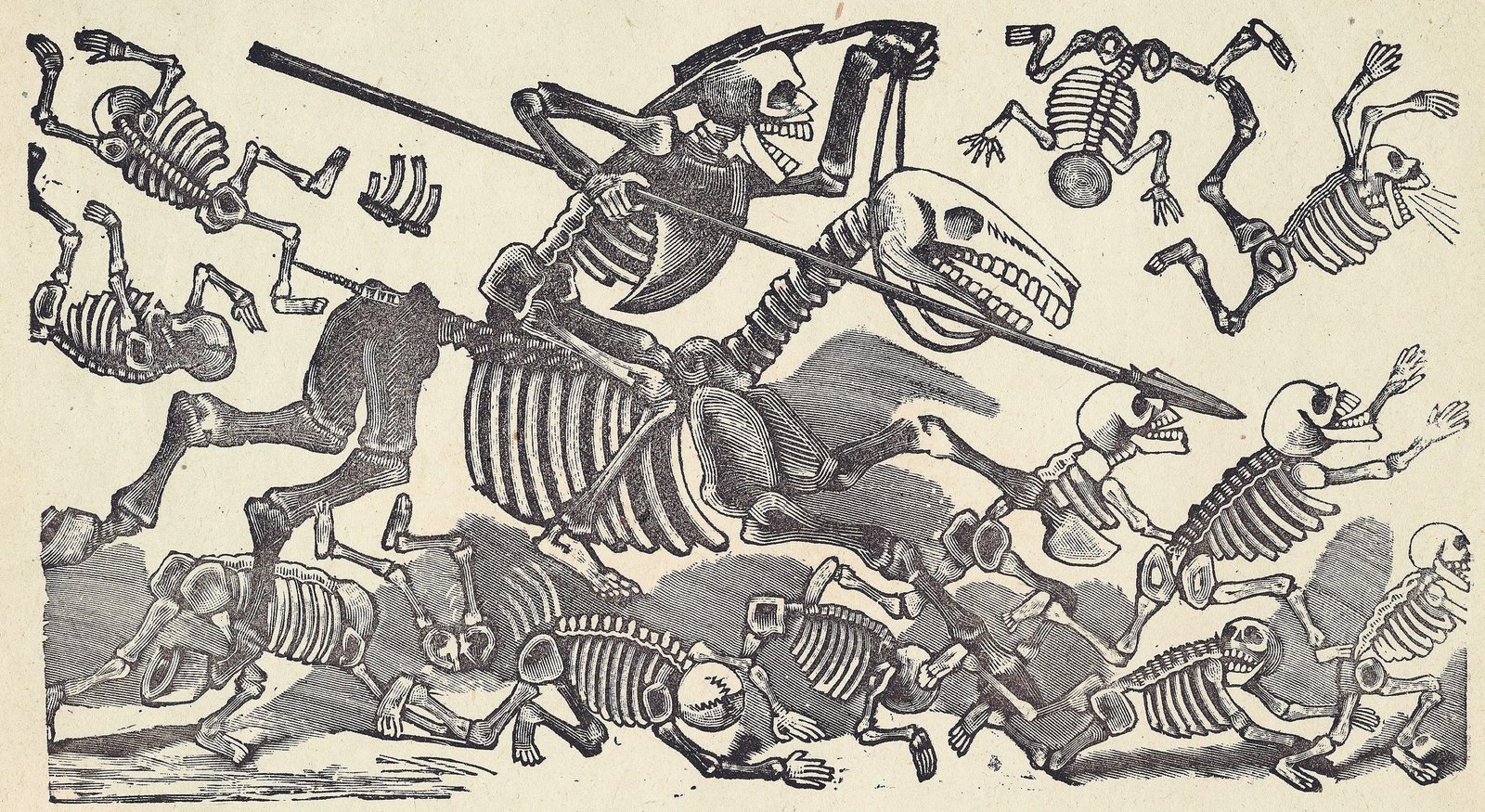
José Guadalupe Posada was born in Aguascalientes in 1852. He arrived in Mexico City in 1888 and joined the publishing world in which Vanegas Arroyo held a prominent place. His illustrations accompanied sensational news, stories, songs, and political satires, in a direct, expressive visual language that was hard to forget. In his hands, skeletons mocked the powerful and starred in absurd scenes.
His work This is Don Quixote's first calavera, the one without equal, the giant calavera, held in the Museum of Modern Art in New York, is an example of how he used this motif in compositions that combined cultural references, humor, and criticism.
Posada had an extraordinary ability to create memorable images. His calaveras could be read quickly, even by people who had no access to formal education. And although an artist's success rarely depends on a single cause, Posada ended up becoming the great name of Mexican popular graphic art associated with the calaveras.
Was it because his images were better? The answer is not that simple. Artistic quality matters, but so do the circulation of the works, the historical circumstances, the preservation of the materials, and the way later generations build their stories about the past. One factor documented by México Desconocido: Diego Rivera replicated Posada's caricatured skeletons in his mural Dream of a Sunday Afternoon in the Alameda Park.
Art history is not a competition with an impartial jury handing out medals at the end of each century.
Who Drew the Calaca First?
José Guadalupe Posada took the fame, but Manuel Manilla was already drawing the calaveras we now identify with the Day of the Dead before him. At least that is what records and studies by recognized researchers indicate. Both were linked to the Vanegas Arroyo printing house, and Manilla was collaborating with the publisher before Posada arrived. The Museum of Modern Art in New York notes that the calavera motif was probably introduced by Manilla and that Posada popularized it until it became a national symbol.
But the answer is that we do not have a definitive, universally accepted date for Manuel Manilla's first calavera. Nineteenth-century popular graphic art worked through processes of collaboration, reproduction, and adaptation. Some images circulated without clear identification of their authors, and certain attributions remain under study. In August 2026, at the discussion ‘Mapping Posada’ at the Museo Nacional de la Estampa, curator Caroline Montenat noted that confusion persists between works by Posada and Manilla.
From Cheap Prints to the World's Museums
The irony is that those images created for popular publications ended up becoming objects of study, collecting, and international exhibition. Today Posada's engravings are in important museum collections, and La Catrina has acquired a cultural life that far exceeds the original context of its depictions. Manilla has received less public attention, but his work has also been the subject of research, exhibitions, and recovery efforts.
A popular print, a broadsheet, or an ephemeral publication can preserve decisive information about the artists, the publishers, and the tastes of an era. In the art market, correctly identifying a work and understanding its provenance are essential tasks. Precisely for that reason, research into nineteenth-century Mexican graphic art is so fascinating: each piece can help reconstruct a story that still has chapters pending.
Manuel Manilla Deserves to Come Out of the Shadows
There is something profoundly unjust about remembering a tradition by a single name when its development was the work of several people. Certainly, Posada deserves the recognition he has received. His talent, his narrative ability, and his influence on Mexican visual culture are indisputable. But Manilla deserves something more than a footnote.
He was an engraver who worked for the public of his time, who helped develop a visual language in which death could mock the living, and who preceded Posada in the workshop where the calaveras gained an extraordinary presence. If Posada was the artist who carried those images to lasting fame, Manilla was one of the creators who prepared the ground for that to happen.
José Guadalupe Posada has his place in history. The time has come to give Manuel Manilla his.